CUSHING STREET POETRY
a reading by
PAUL KLINGER &
STEFANIE MARLIS
8:00 pm, Tuesday, May 9, 2006
at Cushing Street Bar & Restaurant, on the patio
198 W. Cushing Street
in Tucson, Arizona
just south of Tucson Convention Center
1 block east of Main Street
admission is FREE
Sunday, April 30, 2006
Saturday, April 29, 2006
from Deborah Bernhardt's Echolalia
Her Lost Draft
The isn't of art.
Lose something every.
Lost door, hour badly spent.
Practice losing, losing.
You
travel. None will bring.
Watch. And look! my last, or
next-to-last, of three loved
went.
I lost
some realms I owned.
But it wasn't an Elizabeth.
(The joking voice.) Too hard
may look like (Write it!) like
One Art.
Hard to master, though it disaster,
the intent. Their loss. Accept
keys. Accept
the intent where it was meant.
Lost I: my mother's.
A disaster.
--Even losing You, I love.
I shan't.
Of losing:--the fluster.
More poems and info here.
The isn't of art.
Lose something every.
Lost door, hour badly spent.
Practice losing, losing.
You
travel. None will bring.
Watch. And look! my last, or
next-to-last, of three loved
went.
I lost
some realms I owned.
But it wasn't an Elizabeth.
(The joking voice.) Too hard
may look like (Write it!) like
One Art.
Hard to master, though it disaster,
the intent. Their loss. Accept
keys. Accept
the intent where it was meant.
Lost I: my mother's.
A disaster.
--Even losing You, I love.
I shan't.
Of losing:--the fluster.
More poems and info here.
Friday, April 28, 2006
CUE4 Now Available
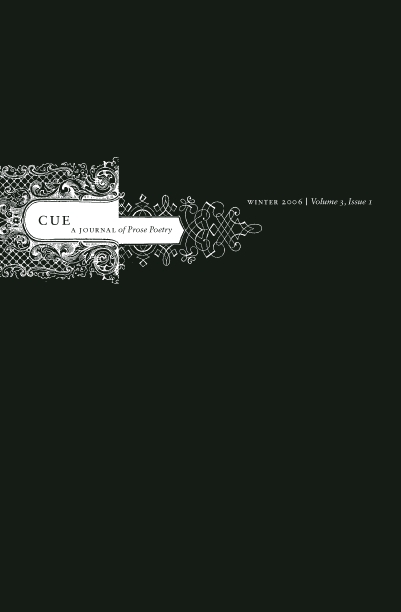
After a long winter hibernation, the fourth issue of CUE is finally available, and includes awesome new work by Michael Palmer, David Lehman, G.C. Waldrep, Lisa Jarnot, Brian Clements, Dan Hoy, Andrew Zawacki, Jason Zuzga, Stephanie Balzer, Brandon A. Wyant, among others. Individual copies are $6, a year subscription (2 issues) is $10, 2 years $16. Coming up at the end of the summer, new work by John Ashbery, Rosmarie Waldrop, Boyer Rickel, Karen Volkman, Peter Jay Shippy, Michael Schiavo, Michael Rerick, Joshua Marie Wilkinson and more.
Wednesday, April 26, 2006
Hart Crane (July 21, 1899 - April 27, 1932)

The Broken Tower
The bell-rope that gathers God at dawn
Dispatches me as though I dropped down the knell
Of a spent day - to wander the cathedral lawn
From pit to crucifix, feet chill on steps from hell.
Have you not heard, have you not seen that corps
Of shadows in the tower, whose shoulders sway
Antiphonal carillons launched before
The stars are caught and hived in the sun's ray?
The bells, I say, the bells break down their tower;
And swing I know not where. Their tongues engrave
Membrane through marrow, my long-scattered score
Of broken intervals ... And I, their sexton slave!
Oval encyclicals in canyons heaping
The impasse high with choir. Banked voices slain!
Pagodas campaniles with reveilles out leaping-
O terraced echoes prostrate on the plain! ...
And so it was I entered the broken world
To trace the visionary company of love, its voice
An instant in the wind (I know not whither hurled)
But not for long to hold each desperate choice.
My world I poured. But was it cognate, scored
Of that tribunal monarch of the air
Whose thighs embronzes earth, strikes crystal Word
In wounds pledges once to hope - cleft to despair?
The steep encroachments of my blood left me
No answer (could blood hold such a lofty tower
As flings the question true?) -or is it she
Whose sweet mortality stirs latent power?-
And through whose pulse I hear, counting the strokes
My veins recall and add, revived and sure
The angelus of wars my chest evokes:
What I hold healed, original now, and pure ...
And builds, within, a tower that is not stone
(Not stone can jacket heaven) - but slip
Of pebbles, - visible wings of silence sown
In azure circles, widening as they dip
The matrix of the heart, lift down the eyes
That shrines the quiet lake and swells a tower...
The commodious, tall decorum of that sky
Unseals her earth, and lifts love in its shower.
Monday, April 24, 2006
More Eunoia
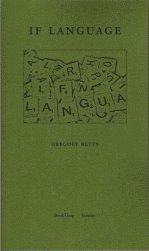
Been reading Gregory Betts' If Language (Book Thug, Toronto) which arrived in the mail a few months ago, and which I've just now taken up. If you dig the ludic insanity of constraint-based writing (a la Christian Bok's Eunoia, or the "Variations" Kevin McFadden has been publishing, or anything Oulipo-related), If Language could be considered one more brilliant example of what's happening north of the border these days. Conceptually, the book departs from a paragraph by the L=A=N=G=U=A=G=E poet Steve McCaffery. I reproduce it here in full:
"If Language Writing successfully detaches Language from the historical purpose of sumarizing global meaning replacing the goal of totality with the free polydynamic drive of parts, it nevertheless falls short in addressing the full implications of this break and seems especially to fail in taking full account of the impact of the human subject with the thresholds of linguistic meaning. It is a the critical locus of productive desire that this writing opens itself up an alternative "libidinal" economy which operates across the precarious boundaries of the symbolic and the biological and has its basis in intensities."
from "Language Writing: from Productive to Libidinal Economy"
If you count the constituent letters of McCaffery's paragraph--and Betts has--there are a total of 525, 56 of which are--not un-ironically--the letter "I." Moreover, there are 48 t's, 49 e's, 42 a's, etc. What Betts is up to in If Language he declares early on--"a reorganization" of the "literal-letteral constituents" of McCaffery's paragraph, a perfect anagrammatical re-arrangement, with the original quote serving as "the theoretical springboard, the palette, the keyboard for [his] hopeful obsession," and without surplus, each paragraph a perfect efficiency. Here's one example of what Betts comes up with:
"Today it will be music degrees of collage with a litter of sun petroleum and solace, hi-fi of sickishness, obliged by a conservative force that, it is hopeful, will fulminate in the social realities of committed principalities. Someone's parents slip back into an ungracious war front that agitates the alliance and physiognomy of illuminating gases threatening shift. By tonight, a the mausoleum parade, the light scoffing carbuncular air should eroticize its partly visible superobjectivism. Plush gallows hiss. There is a fifty percent chance of fifth and eighth dimensions contrasting that should clear up all things considered."
What sort of writer has the patience to pull off this kind of project? Well, the same writer who writes 56 such poems, all anagrams, each mining its constituent language for a range of tones and idioms. As collections go, If Language is at once inspired and humbling. If you're interested in seeing more, pick up a copy at http://www.bookthug.ca
Sunday, April 23, 2006
Mandatory New Reading

I've been waiting for a book like this to cross my path. Deborah Bernhardt's Echolalia is brilliant. Once I get myself together I'll post more extensive comments, but for now consider this book a must read.
Saturday, April 22, 2006
Done & Done
The manuscript for Verge is finally finished! To my friends, I'll be getting you all copies in the mail soon. Keep an eye out.
Now, like everyone else, all I need is a publisher...
Now, like everyone else, all I need is a publisher...
Wednesday, April 19, 2006
LIT 11 Debut
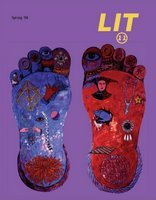
LIT 11 contains poetry and prose by Samuel Amadon * Anne Boyer * Michael Burkard * Heather Christle * Adam Clay * Bruce Covey * Lisa Croneberg * Katie Degentesh * Stephen Dixon * Stephen Dunn * Russell Edson * Jim Goar * Nada Gordon * Rae Gouirand * Kate Greenstreet * Christine Grillo * James Grinwis * Joshua Harmon * Jennifer Michael Hecht * Nathan Hoks * Nicolas Hundley * Lisa Jarnot * Brian Kalkbrenner * Amy King * Caroline Knox * Justin Lacour * Ben Lerner * Timothy Liu * Michael Loughran * David McAleavey * Anthony McCann * Marc McKee * Corey Mead * Peter Mishler * Ange Mlinko * Dennis Must * Philip Nikolayev * D. Nurkse * Geoffrey O'Brien * Jacquelyn Pope * Jerome Rothenberg * Kevin Sampsell * Greg Sanders * Cindy Savett * Morgan Lucas Schuldt * Andrew Seguin * Spencer Selby * David Silverstein * Rick Snyder * Chris Stroffolino * Nova Ren Suma * Rosmarie Waldrop * Alli Warren * Elisabeth Whitehead * David Wilson * Xue Di * Art by Jane Hammond
Tuesday, April 18, 2006
Barthes on Flayed
"The resistance of the wood varies depending on the place where we drive in the nail: wood is not isotropic. Nor am I; I have my 'exquisite points.' The map of these points is known to me alone, and it is according to them that I make my way, avoiding or seeking this or that, depending on externally enigmatic counsel; I should like this map of moral acupuncture to be distributed preventitively to my new acquaintances (who, moreover, could also utilize it to make me suffer more)."
Sunday, April 16, 2006
Good or Bad Foot
Does anyone know if Goodfoot remains in business? The Goodfoot website hasn't been updated in three years.
Good News
The Massachusetts Review has nominated "The Mortician on the Art of Coming to Rest" for the Best New Poets 2006 anthology, published through the University of Virginia and its literary journal, Meridian. Thanks to Ellen Watson, poetry editor of the MR, for the honor. If you haven't heard about this newish anthology, check it out at http://www.bestnewpoets.org/
Saturday, April 15, 2006
Mall or May?
"The pure work implies the eluctionary disappearance of the poet, who yields place to the words, immobilized by the shock of their inequality; they take light from mutual reflection, like an actual train of fire over precious stones, replacing the old lyric afflatus or the enthusiastic personal direction of the phrase."
-Mallarme
-Mallarme
Thursday, April 13, 2006
The Wright Way
"Poetry comes, for lack of better words, from the heart (the "foul rag-and-bone-shop of the heart," as Yeats had it), and from the soul—neither a place you can put your finger on, but a place you can surely put your foot in, if you don't watch out. It is a matter of "soul making," as John Keats said. It truly is not a matter of arrangement, of performance, of presentation, or rhetorical dazzle or surprise, though all of those matters may be part of it. It is not the distractions, but the focus. It is not the undercard, but the main event. There is always an emotional half to the equation, but the other half is always craft—you have to be able to say it your way. It's the only time that two plus one makes two—language is half, technique is half, and emotion is half. An emotional value is always involved. Distortions and side events are often interesting and entertaining, but they are not the stillness and fathered attention at road's end. It's not a question of paper, or type-writers, of white space or of dark space—it's a question of what's in your life, and where you want that life to lead you. You've only got one, and you can fill it with whatever you want. You're free and American. But if it is poetry that you want, then don't look for language games, intellectual rip-offs, or rhetorical sing-alongs. It's too often been a matter of life and death to those who really cared. You've got to know, in your heart of hearts, that Keats is right, that it is about soul-making, that it does matter, and that it can make you or break you as a person. It is the main event, as I say, and ancillary to nothing. It's either Atonement or At Onement, but it is one of them."
-Charles Wright
-Charles Wright
Wednesday, April 12, 2006
The Resistance
Some great advice over at Lisa's blog:
http://www.angelfire.com/poetry/lisajarnot/blog/
Check out the entry for Tuesday, April 11
http://www.angelfire.com/poetry/lisajarnot/blog/
Check out the entry for Tuesday, April 11
Crane Theory
"It is my hope to go through the combined materials of the poem, using our "real" world somewhat as a spring-board, and to give the poem as a whole an orbit or predetermined direction of its own. I would like to establish it as free from my own personality as from any chance evaluation on the reader's part. (This is, of course, an impossibility, but it is a characteristic worth mentioning.) Such a poem is at least a stab at truth, and to such an extent may be differentiated from other kidns of poetry and called "absolute." Its evocation will not be toward decoration or amusement, but rather toward a state of consciousness, an "innocence" (Blake) or absolute beauty. In this condition there may be discoverable under new forms certain spiritual illuminations, shining with a morality essentialized from experience directly, and not from pervious precepts or preconceptions. It is as though a poem gave the reader as he left it a single, new word, never before spoken and impossible to actually enunciate, but self-evident as an active principle in the reader's consciousness henceforward."
Hart Crane
from "General Aims and Theories," 1925
Hart Crane
from "General Aims and Theories," 1925
Monday, April 10, 2006
CUSHING STREET POETRY
POG plus CHAX PRESS plus CUSHING STREET PRESENT
CUSHING STREET POETRY
a reading by
MICHAEL GREGORY
NORA NICKERSON
8:00 pm, Tuesday, April 11, 2006
at Cushing Street Bar & Restaurant, on the patio
198 W. Cushing Street
in Tucson, Arizona
just south of Tucson Convention Center
1 block east of Main Street
admission is FREE
CUSHING STREET POETRY
a reading by
MICHAEL GREGORY
NORA NICKERSON
8:00 pm, Tuesday, April 11, 2006
at Cushing Street Bar & Restaurant, on the patio
198 W. Cushing Street
in Tucson, Arizona
just south of Tucson Convention Center
1 block east of Main Street
admission is FREE
Friday, April 07, 2006
Wednesday, April 05, 2006


Monday, April 03, 2006
The Other Sighed of Modernism
If you're lonely tonight, there's always the dirty letters of Joyce...
http://www.arlindo-correia.com/joyce.html
http://www.arlindo-correia.com/joyce.html
Subscribe to:
Posts (Atom)