Monday, June 26, 2006
Saturday, June 24, 2006
Friday, June 23, 2006
Sound Poetry
For any number of reasons--not the least of which is the fact that it taught me how to violate language in my own work--the below poem is one of my favorites. And while, yes, it's a translation, it's still quite a ride.
Incantation by Laughter
by Velimir Khlebnikov transliterated by Gary Kern
O laugh it out, you laughsters!
O laugh it up, you laughsters!
So they laugh with laughters, so they laugherize delaughly.
O laugh it up belaughably!
O the laughingstock of the laughed upon–the laugh of
Belaughed laughsters!
O laugh it out roundlaughingly, the laugh of laughed-at
Laughians!
Laugherino, laugherino,
Laughify, laughicate, laugholets, laugholets,
Laughikins, laughikins,
O laugh it out, you laughsters!
O laugh it up, you laughsters!
According to Khlebnikov poetry aspires to zaum, what he describes as a "universal beyonsense." As Marjorie Perloff describes it in her book 21st Century Modernism: The "New" Poetics, zaum is based "less on 'non-sense' onomatopoeia than on elaborate etymology... phonemic and morphemic play" which can "produce a poetic language beyond (za) mind or reason (um)."
Incantation by Laughter
by Velimir Khlebnikov transliterated by Gary Kern
O laugh it out, you laughsters!
O laugh it up, you laughsters!
So they laugh with laughters, so they laugherize delaughly.
O laugh it up belaughably!
O the laughingstock of the laughed upon–the laugh of
Belaughed laughsters!
O laugh it out roundlaughingly, the laugh of laughed-at
Laughians!
Laugherino, laugherino,
Laughify, laughicate, laugholets, laugholets,
Laughikins, laughikins,
O laugh it out, you laughsters!
O laugh it up, you laughsters!
According to Khlebnikov poetry aspires to zaum, what he describes as a "universal beyonsense." As Marjorie Perloff describes it in her book 21st Century Modernism: The "New" Poetics, zaum is based "less on 'non-sense' onomatopoeia than on elaborate etymology... phonemic and morphemic play" which can "produce a poetic language beyond (za) mind or reason (um)."
Thursday, June 22, 2006
Avant-ness
Back in March I posted an excerpt from an interview with Dean Young in which he suggested that it's now all but impossible for any sort of meaningful (or fruitful) avant-garde to exist today. And yet this feeling is nothing new. Guess who wrote the following, and when?:
"Previously, vanguard artists never had to face the problems of integration into the art of their time because this usually happened at the end of a long career when the direction their art would take had long been fixed. When it took place earlier it could be dealt with by an explosition of bad temper, as in the possibly apocryhal story about Schonberg: when someone finally learned to play his violin concerto he stormed out of the concert hall, vowing to write another one that nobody would be able to play.
Today the avant-garde has come full circle--the artist who wants to experiment is again faced with what seems like a dead end, except that instead of creating in a vacuum he is now at the center of a cheering mob."
The answer is Ashbery. In 1968!
I'd like to raise the possibility that so much bland, over-determined poetry gets written today out of a fear of naivite. In the aftermath of the marriage between poetry and literary theory in the 70's and 80's, a marriage that's been playing out ever since, there's a palpable fear of NOT aspiring toward an intellectual poetry.
Or put it this way--a sculptor doesn't need to be a geologist in order to see the shape in the stone. Sensibility and intuition have a way of carrying us pretty damn far. Time for the pendulum to swing the other way.
More on this in future posts.
"Previously, vanguard artists never had to face the problems of integration into the art of their time because this usually happened at the end of a long career when the direction their art would take had long been fixed. When it took place earlier it could be dealt with by an explosition of bad temper, as in the possibly apocryhal story about Schonberg: when someone finally learned to play his violin concerto he stormed out of the concert hall, vowing to write another one that nobody would be able to play.
Today the avant-garde has come full circle--the artist who wants to experiment is again faced with what seems like a dead end, except that instead of creating in a vacuum he is now at the center of a cheering mob."
The answer is Ashbery. In 1968!
I'd like to raise the possibility that so much bland, over-determined poetry gets written today out of a fear of naivite. In the aftermath of the marriage between poetry and literary theory in the 70's and 80's, a marriage that's been playing out ever since, there's a palpable fear of NOT aspiring toward an intellectual poetry.
Or put it this way--a sculptor doesn't need to be a geologist in order to see the shape in the stone. Sensibility and intuition have a way of carrying us pretty damn far. Time for the pendulum to swing the other way.
More on this in future posts.
Sunday, June 18, 2006
TV
How much do I love HBO? A lot.
So I'll go ahead and say it--hands down, the best show on television is Deadwood.
So I'll go ahead and say it--hands down, the best show on television is Deadwood.
Saturday, June 17, 2006
New Mullen
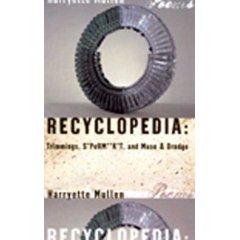
I've been waiting for something like this--a collected of Mullen's three books from the 90's--Trimmings, S*PeRM**K*T and Muse & Drudge. Having started CUE years after the debut of Sleeping with the Dictionary, I now, finally, have an excuse to write on Mullen for the journal. It's a surprising publishing venture for Graywolf, an aesthetic departure of sorts for a press I, at least, think of as rather conservative. Nevertheless, I'm thrilled Recyclopedia--as it'll be called--will be available this fall.
Also coming in the fall: (especially for you, Mark) Lynda Hull's Collected Poems and Tony Hoagland's book of essays, Real Sofistikashun.
Crane Theory
So I finished the Clive Fischer biography of Hart Crane. As it is with Crane biographies, it was a wrenching experience, particularly toward the end when Crane's drinking--always heavy--takes on a life of its own.
But as far as biographies of Crane go, I still hold that the Paul Mariani bio, The Broken Tower, is the best read, if only for how much more time Mariani spends mulling over Crane's poems, especially The Bridge.
There was one Crane blurb (perhaps from a letter to Laura Riding, I'm not sure) that was particularly heartening:
"It is part of a poet's business to risk not only criticism--but folly--in the conquest of consciousness."
I love that. "Conquest" may be a bit strong, perhaps too militaristic for my taste, but I relate to the idea of risking folly. Risking something big in my writing. I guess because I'd rather be accused of over-indulgence than boredom.
But as far as biographies of Crane go, I still hold that the Paul Mariani bio, The Broken Tower, is the best read, if only for how much more time Mariani spends mulling over Crane's poems, especially The Bridge.
There was one Crane blurb (perhaps from a letter to Laura Riding, I'm not sure) that was particularly heartening:
"It is part of a poet's business to risk not only criticism--but folly--in the conquest of consciousness."
I love that. "Conquest" may be a bit strong, perhaps too militaristic for my taste, but I relate to the idea of risking folly. Risking something big in my writing. I guess because I'd rather be accused of over-indulgence than boredom.
Monday, June 05, 2006
Notes on the Ashbery Poem to Appear in CUE
Tonight I received a letter from John Ashbery, a follow up to the "prose poem" he was generous enough to pass along to CUE. First off, it's absolutely crazy to hold in my hands a piece of paper Ashbery took time to fold in thirds and place in an envelope. But high school crushes aside, included was a short note explaining the circumstances in which the text (which will appear in issue 5) was written. Below is the note--reproduced in full--as it will appear in CUE:
"This text was orginally written (in 2002) as part of a collaborative film project at the request of Yan Brailowsky, then a French diplomat living in New York. Five writers (Donald Breekenridge, Frederic-Yves Jeannet, Ron Padgett, John Yau, and Ashbery) were asked to 'contribute a maximum of one page of dialogue (and a minumum of one sentence)--"dialogue" being understood as "words uttered by at least one character." Each person has been proposed one of the five themes chosen: "yellow," "ears," "smiles," "food," and "little red book." Theme is a loose term you are welcome to interpret as you wish (after all, it's your dialogue.) [Ashbery's] theme would be "little red book."' It was also stipulated that the lines of dialogue could be used out-of-sequence."
Intriguing, yes. But here's the kicker:
"An initial script has been prepared, but the film has not yet been made. Brailowsky wants Ashbery to play the role of the Pope."
I laughed my ass of at that last part, trying to imagine Ashbery in one of those looming Pope hats...classic.
Publication in the same issue of CUE as Ashbery for anyone who writes a great prose poem that includes this scenario--a filmaker cajoling Ashbery to play the Pope.
I'm serious.
"This text was orginally written (in 2002) as part of a collaborative film project at the request of Yan Brailowsky, then a French diplomat living in New York. Five writers (Donald Breekenridge, Frederic-Yves Jeannet, Ron Padgett, John Yau, and Ashbery) were asked to 'contribute a maximum of one page of dialogue (and a minumum of one sentence)--"dialogue" being understood as "words uttered by at least one character." Each person has been proposed one of the five themes chosen: "yellow," "ears," "smiles," "food," and "little red book." Theme is a loose term you are welcome to interpret as you wish (after all, it's your dialogue.) [Ashbery's] theme would be "little red book."' It was also stipulated that the lines of dialogue could be used out-of-sequence."
Intriguing, yes. But here's the kicker:
"An initial script has been prepared, but the film has not yet been made. Brailowsky wants Ashbery to play the role of the Pope."
I laughed my ass of at that last part, trying to imagine Ashbery in one of those looming Pope hats...classic.
Publication in the same issue of CUE as Ashbery for anyone who writes a great prose poem that includes this scenario--a filmaker cajoling Ashbery to play the Pope.
I'm serious.
Editorial
Will someone please explain to me the logic of the (printed) poetry journal that runs into the hundreds of pages? Why the warehouse? What sort of reading experience are we being presented with? Are we to survey it as we would an anthology, dipping our toe every now and then? I ask as an editor who favors modesty, intimacy, and, well, some form of totality from his reading experience.
Sunday, June 04, 2006
Klee
"Man's ability to measure the spiritual, earthbound, and cosmic, set against his physical helplessness is his fundamental tragedy. The tragedy of spirituality."
-Paul Klee
-Paul Klee
Friday, June 02, 2006
Emerson 2
"[T]he poet is the Namer or Language-maker, naming things sometimes after their appearance, sometimes after their essence, and giving to every one its own name and not another's, thereby rejoicing the intellect, which delights in detachment or boundary. The poets made all the words, and therefore language is the archives of history, and, if we must say it, a sort of tomb of the muses. For, though the origin of most of our words is forgotten, each word was at first a stroke of genius, and obtained currency, because for the moment it symbolized the world to the first speaker and to the hearer. The etymologists finds the deadest word to have been once a briliant picture. Language is fossil poetry."
from "The Poet"
from "The Poet"
Subscribe to:
Posts (Atom)