Now that I'm on a home IV antibiotic regiment, I'm tethered to a bag of drugs every six hours, every day, for two weeks. It's a strict regiment that has me finishing my last dose at 1 a.m. and starting my next one up as the sun rises around 6 a.m. As it is, I'm not sleeping much, but I am feeling a lot better.
Other than a few hours here and there, I'm also not getting out of my apartment much, but today, I was determined to do something other than take care of myself, so I headed over to Bookman's. For those of you not familiar with the Tucson scene, Bookman's is an amazing chain of used-book stores, and for a guy who grew up in Jersey frequenting garage sales and flea markets on sundays with his grandparents, it's a place that reminds one of the pleasures of persistent browsing. I came across some real finds today--
Walt Whitman's America: A Cultural Biography by David S. Reynolds (a like new copy of this finalist for the National Book Critics Circle Award back in '95)
James Joyce by Richard Ellmann (the best and most definitive biography on Joyce ever written, or so I hear--I haven't yet had the chance to read it. Finally, my own copy...)
The New Princeton Encyclopedia of Poetry and Poetics (a new hard-cover edition for only $10!)
A sweet-smelling copy of a ragged pocket edition of French Symbolist poetry for $2.
Also in the mail today I received my copies of Paul Guest's first book, The Resurrection of the Body and the Ruin of the World, and his new chapbook, Exit Interview, from New Michigan Press. I love receiving books in the mail, and, in fact, I'm still waiting on a new copy of Finnegans Wake to replace my worn, coverless Penguin edition. I'll have to transfer underlining and marginalia to the new edition, which is annoying, but, then again, I won't have to worry anymore about losing pages or holding the whole thing together with a rubber-band.
Ah, life's little trade-offs.
Wednesday, September 27, 2006
Sunday, September 24, 2006
Sunday Round-Up
Favoritism in choosing best American poets? Naw... Who woulda thought...
~
Elif Shafak acquitted.
~
More recognition and accolades for Adrienne Rich who, well, already has recognition and accolades.
~
Best books on the English language?
~
Mr. B, your favorite holiday--it's national punctuation day today!
~
Steph--something to do with your books.
~
Elif Shafak acquitted.
~
More recognition and accolades for Adrienne Rich who, well, already has recognition and accolades.
~
Best books on the English language?
~
Mr. B, your favorite holiday--it's national punctuation day today!
~
Steph--something to do with your books.
Saturday, September 23, 2006
A Poem
Yesterday's experiences had me digging through old poems (mostly prose poems) wherein the subject of the body was much more explicitely at the forefront of my poetic pre-occupations. The poem below is still one of my favorites. It first appeared in Chelsea.
Browsing the Adult Section
Masturbation, you want to remind all the wide-eyed, prurient faces, can best be understood as a kind of preparation for living. The body’s late-night writhe and shudder; the practiced hand’s early morning rub-and-pump. All the various mid-day skulkings about, ears alert, tilted towards car-doors and deadbolts, familiar voices outside calling our return so that during those groaning surges our senses become so heightened that they block us up inside ourselves, and we go from one form of grasping to another. The mind staring in on worlds it creates, worlds consisting without scale and everything it can make of a body—torsos fleshed out to pliant twining legs, knocking breasts and all those slick candied places. Clefts and crevices and strong sweet supple sprawls of delirious eight-sided orgies. Swart hairs matted down by anonymous tongues, mouths grazing our most private ridiculous seductions and weirdest kinks. Where does the life of the imagination leave off, the life of the body begin? What are these fantasies but boundaries, thresholds, secret acts that go on only inside ourselves, which should therefore best not go on at all. Because behind the eyes, we learn early, is where life happens, where we learn double-ness, what a lie is and a certain practical complacence. And you, back at your desk, are thinking how, because none of it really happens, they’ll do everything they want and do it better; letting fantasy climb on its own up and out to wish for some relief from the self. The same deep place, in this moment, where comes a sigh upward against your body. A half-face in the half-dark of the bedroom before closing her eyes. There, below you, she looks concentrated, serious, as if in pain, hoping you can forgive her somehow for leaving you behind, and which, if you could keep from leaving her, you would.
~
Browsing the Adult Section
Masturbation, you want to remind all the wide-eyed, prurient faces, can best be understood as a kind of preparation for living. The body’s late-night writhe and shudder; the practiced hand’s early morning rub-and-pump. All the various mid-day skulkings about, ears alert, tilted towards car-doors and deadbolts, familiar voices outside calling our return so that during those groaning surges our senses become so heightened that they block us up inside ourselves, and we go from one form of grasping to another. The mind staring in on worlds it creates, worlds consisting without scale and everything it can make of a body—torsos fleshed out to pliant twining legs, knocking breasts and all those slick candied places. Clefts and crevices and strong sweet supple sprawls of delirious eight-sided orgies. Swart hairs matted down by anonymous tongues, mouths grazing our most private ridiculous seductions and weirdest kinks. Where does the life of the imagination leave off, the life of the body begin? What are these fantasies but boundaries, thresholds, secret acts that go on only inside ourselves, which should therefore best not go on at all. Because behind the eyes, we learn early, is where life happens, where we learn double-ness, what a lie is and a certain practical complacence. And you, back at your desk, are thinking how, because none of it really happens, they’ll do everything they want and do it better; letting fantasy climb on its own up and out to wish for some relief from the self. The same deep place, in this moment, where comes a sigh upward against your body. A half-face in the half-dark of the bedroom before closing her eyes. There, below you, she looks concentrated, serious, as if in pain, hoping you can forgive her somehow for leaving you behind, and which, if you could keep from leaving her, you would.
Friday, September 22, 2006
The Body
Last sunday I woke with a pain in my side, just about where the rib cage begins its taper into the spine, the exquisite kind of pain that's both sharp with sudden movement and dull and throbbing when at rest, the inexplicable kind that shoots from the back through to the front of the chest and that prevents deep breaths and coughing of any kind. Well, that pain receded a bit this past week until today when I coughed blood--not a lot, but enough that I called my doctor who immediately directed me to the emergency room for x-rays. Five hours and a rather vague diagnosis later, it turns out that, after only one month from my last hospitalization, I've got brewing the beginnings of yet another chest infection. Since Cipro no longer works (my body has grown resistant to just about every antibiotic), I'm on course to do another two-week round of iv antibiotics, the only antibiotics that work for me now. Whether this latest treatment finds me in the hospital again, or at home, I won't know until monday. What I do know is that I'm angry. And frustrated. It's nearly impossible to come to terms with one's own body working so vehemently against itself. I don't mind exerting all the time and energy I do three times a day doing treatments and physical therapies, but when that isn't enough, what can one do? All I want to do is write poetry.
The body isn't a theory. Just wait and see. We're all sealed-in facts.
The body isn't a theory. Just wait and see. We're all sealed-in facts.
Monday, September 18, 2006
Sunday, September 17, 2006
Sunday Poetry Round-up
First poem of the Americas uncovered.
~
Laura Bush snubbing poets yet again?
~
The Kenyon Review and Ploughshares both have blogs.
~
Video killed the organically-written poetry collection.
~
Bob Dylan and confederate verse.
~
Laura Bush snubbing poets yet again?
~
The Kenyon Review and Ploughshares both have blogs.
~
Video killed the organically-written poetry collection.
~
Bob Dylan and confederate verse.
Friday, September 15, 2006
CUE5 Coming Soon
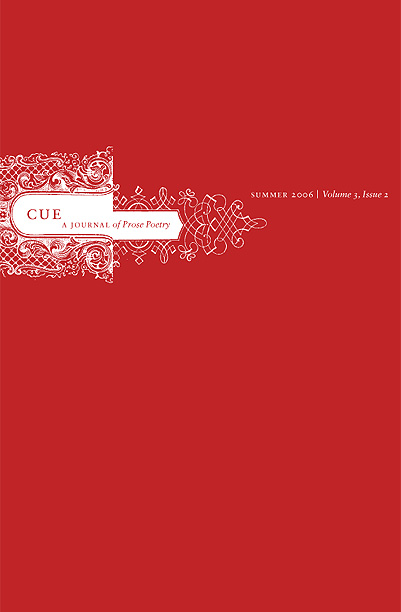
CUE5
John Ashbery
Rosmarie Waldrop
Campbell McGrath
Boyer Rickel
Michael Schiavo
Peter Jay Shippy
Joshua Marie Wilkinson
Christoph Casamassima
Michael Rerick
Steve Timm
& two prose poems by Angel Crespo, translated from the Spanish by Steven J. Stewart
We've still got some back issues of CUE we'd like to find homes for. Check out our subscription page for details.
Thursday, September 07, 2006
Tucson Poetry Round-up
Some up-coming readings:
University of Arizona Poetry Center
presents Albert Goldbarth
Tonight, Thurs. Sept 7, 8pm
at Modern Languages Auditorium
WIP Reading
U of A grad students Jamie Poissant, Peter Derby, Lauren Eggert-Crowe
7pm Friday, Sept. 8
at Casa Libre, located on the east side of 4th Ave., between 8th and 9th streets
Cushing Street Poetry (sponsored by Chax Press and POG)
a reading by Sue Carnahan & Aarcon Cohick
8pm, Tuesday, Sept. 12
at Cushing Street Bar and Restaurant, on the patio
198 W. Cushing St.
For an update on development plans for the Tucson Historic Warehouse Arts District, check out the Chax blog. The news doesn't sound promising.
Also, if you've contributed to CUE and you're going to be in Atlanta for AWP, CUE and Casa Libre are putting together a reading. If you're interested, the details are over at Steph's blog.
University of Arizona Poetry Center
presents Albert Goldbarth
Tonight, Thurs. Sept 7, 8pm
at Modern Languages Auditorium
WIP Reading
U of A grad students Jamie Poissant, Peter Derby, Lauren Eggert-Crowe
7pm Friday, Sept. 8
at Casa Libre, located on the east side of 4th Ave., between 8th and 9th streets
Cushing Street Poetry (sponsored by Chax Press and POG)
a reading by Sue Carnahan & Aarcon Cohick
8pm, Tuesday, Sept. 12
at Cushing Street Bar and Restaurant, on the patio
198 W. Cushing St.
For an update on development plans for the Tucson Historic Warehouse Arts District, check out the Chax blog. The news doesn't sound promising.
Also, if you've contributed to CUE and you're going to be in Atlanta for AWP, CUE and Casa Libre are putting together a reading. If you're interested, the details are over at Steph's blog.
Wednesday, September 06, 2006
Poetry Magazine
If its author John Barr (admitted president of the Poetry Foundation and former board member of the Poetry Society of America, Yaddo and Bennington College) didn't take himself half so seriously, one might expect to see his essay, "American Poetry in the New Century", lampooned in the back pages of Poetry's annual "humor issue." As it appears this month, however, the essay (not at all intended to be a tounge-in-cheek send up of anything) reminds one just how easy it's become to laugh at any issue of Poetry, especially when the editors court such ridicule themselves, presuming, as they do, that Poetry retains any kind of aesthetic credibility among those writers it ostensibly wants to instigate into new heights of creative fervor.
A glance at any recent issue confirms how as a platform the magazine is defunct, how in its aesthetic taste decrepid, and has been since at least the 1960's. As if the work in the September issue weren't bad enough (Kevin McFadden and D.A. Powell appear to be the only exceptions), Barr's naive missive might just be the most convoluted pseudo-manifesto-ing Poetry has ever had the obligation to publish. Full of the same lamenting after lost accessibility, the same re-tread schtick about the blight of MFA programs on originiality, and the same old pining after those great days of yore when insurance executives and pediatricians could hold down a job AND re-invent American poetry, one wonders if this is the best PR $150 million dollars can buy.
Barr's thesis: "The manner of [modern poetry] has long been mastered. Modernism has passed into the DNA of the MFA programs. For all its schools and experiments, contemporary poetry is still written in the rain shadow thrown by Modernism. It is the engine that drives what is written today. And it is a tired engine."
Tired, certainly. Nearly as tired as Barr's contradictory posture. Indeed, for an essay concerned with contemporary American poetry's aesthetic laziness (its reliance on Modernist models), this essay indulges the very same laziness it purports to decry. Sadly it's an irony lost on Mr. Barr. Eliot, Stevens, Moore, Williams, Stein, Pound, Frost--each is dished up as a quick quip or easy anecdote, and all in a sappy, self-satisfied tone.
Wanna inspire your poetry, dear writer? Stop worrying about your credentials and follow Ernest Hemingway's example--"live more . . . write better."
How else but as stunningly naive can one describe Barr's essay when, with a straight face and in all earnestness, he asks "Will the next Walt Whitman be an MFA graduate?" Or when we stumble across such hackneyed new-age-isms like this: "Poetry, like a prayer book in the wind, should be open to all pages at once."
Perhaps the most disturbing of Barr's contentions is his belief that poetry must be more entertaining, saying so first in relation to MFA programs: "The effect of these programs on the art form is to increase the abundance of poetry, but to limit its variety. The result is poetry that is neither robust, resonant, nor--and I stress this quality--entertaining . . ." And later, in relation to poetry's wider cultural relevance: "The human mind is a marketplace, especially when it comes to selecting one's entertainment . . ."
If Barr, instead of skimming its surface mythologies, had delved a bit deeper into literary history, he might have remembered how much of what is now considered Modern was, in its time, defiantly erudite, wilfully challenging. That is, the very writers he today reveres aspired to be anything but entertainment back in the day.
If only Barr shared such aspirations . . .
~~~~~~~~~~~~~~~~~~~~~~~~~~~~~~~~~~~~~~~
Matthew takes issue with the essay over at his blog.
A glance at any recent issue confirms how as a platform the magazine is defunct, how in its aesthetic taste decrepid, and has been since at least the 1960's. As if the work in the September issue weren't bad enough (Kevin McFadden and D.A. Powell appear to be the only exceptions), Barr's naive missive might just be the most convoluted pseudo-manifesto-ing Poetry has ever had the obligation to publish. Full of the same lamenting after lost accessibility, the same re-tread schtick about the blight of MFA programs on originiality, and the same old pining after those great days of yore when insurance executives and pediatricians could hold down a job AND re-invent American poetry, one wonders if this is the best PR $150 million dollars can buy.
Barr's thesis: "The manner of [modern poetry] has long been mastered. Modernism has passed into the DNA of the MFA programs. For all its schools and experiments, contemporary poetry is still written in the rain shadow thrown by Modernism. It is the engine that drives what is written today. And it is a tired engine."
Tired, certainly. Nearly as tired as Barr's contradictory posture. Indeed, for an essay concerned with contemporary American poetry's aesthetic laziness (its reliance on Modernist models), this essay indulges the very same laziness it purports to decry. Sadly it's an irony lost on Mr. Barr. Eliot, Stevens, Moore, Williams, Stein, Pound, Frost--each is dished up as a quick quip or easy anecdote, and all in a sappy, self-satisfied tone.
Wanna inspire your poetry, dear writer? Stop worrying about your credentials and follow Ernest Hemingway's example--"live more . . . write better."
How else but as stunningly naive can one describe Barr's essay when, with a straight face and in all earnestness, he asks "Will the next Walt Whitman be an MFA graduate?" Or when we stumble across such hackneyed new-age-isms like this: "Poetry, like a prayer book in the wind, should be open to all pages at once."
Perhaps the most disturbing of Barr's contentions is his belief that poetry must be more entertaining, saying so first in relation to MFA programs: "The effect of these programs on the art form is to increase the abundance of poetry, but to limit its variety. The result is poetry that is neither robust, resonant, nor--and I stress this quality--entertaining . . ." And later, in relation to poetry's wider cultural relevance: "The human mind is a marketplace, especially when it comes to selecting one's entertainment . . ."
If Barr, instead of skimming its surface mythologies, had delved a bit deeper into literary history, he might have remembered how much of what is now considered Modern was, in its time, defiantly erudite, wilfully challenging. That is, the very writers he today reveres aspired to be anything but entertainment back in the day.
If only Barr shared such aspirations . . .
~~~~~~~~~~~~~~~~~~~~~~~~~~~~~~~~~~~~~~~
Matthew takes issue with the essay over at his blog.
Friday, September 01, 2006
Rhetoric
Over the past few months a shift in rhetoric has occured among those who would, to their last tooth and nail, defend our incursion into Iraq, Israel's overzealous invasion of Lebanon and the broader war against Islamic fundamentalists. Co-opting the aura of moral clarity that ostensibly motivated America to fight in WWII, the Bush administration and its lackeys have been conspicuously drawing comparisons between America's involvement in that second world war and our current global "war against terror." Some pundits in the media have even (and almost gleefully) taken to dubbing (or dubya-ing ) it World War III, perhaps hoping that by saying so will instigate the Rapture and Christ's second coming.
Indeed, it was just a few days ago that the inimitably quixotic Mr. Rumsfeld likened those who oppose his failed policies in Iraq to those who, in the late 1930's, sympathized with German fascism and who, later, advocated the appeasement of Adolf Hitler. According to Rumsfeld, those who wonder ever loudly why we're still in Iraq just "seem not to have learned history's lessons."
It's a dangerous time we live in when those who fabricate a war can, in defense of it, toss off such hypberolic rhetoric without ever fearing the kind of meaningful confrontation by journalists that would not only call into question such gross exagerations of the historical record, but that would also, hopefully, begin to restore some scale to the debate and its context.
Keith Olberman may have begun something yesterday when, in what amounted to a channeling of the spirit of one Edward R. Murrow, delivered a much needed chiding to Rumsfeldian logic. Check it out...
Indeed, it was just a few days ago that the inimitably quixotic Mr. Rumsfeld likened those who oppose his failed policies in Iraq to those who, in the late 1930's, sympathized with German fascism and who, later, advocated the appeasement of Adolf Hitler. According to Rumsfeld, those who wonder ever loudly why we're still in Iraq just "seem not to have learned history's lessons."
It's a dangerous time we live in when those who fabricate a war can, in defense of it, toss off such hypberolic rhetoric without ever fearing the kind of meaningful confrontation by journalists that would not only call into question such gross exagerations of the historical record, but that would also, hopefully, begin to restore some scale to the debate and its context.
Keith Olberman may have begun something yesterday when, in what amounted to a channeling of the spirit of one Edward R. Murrow, delivered a much needed chiding to Rumsfeldian logic. Check it out...
Subscribe to:
Posts (Atom)