The most recent issue of Field includes a symposium on Hart Crane. In the brief introduction that precedes the reflections (and genuflections) of Charles Wright (on "Voyages II"), Kevin Prufer (on "My Grandmother's Love Letters"), Elton Glaser (on "O Carib Isle") and others, the following assertion is made:
"From the time of Crane's death until the mid-1970's, there seemed to be a concerted effort to promote him as a major poet. That effort, essentially, has failed. There are simply too many problems of diction, syntax, prosody, structure, and vision in Crane's work to validate that kind of claim. But perhaps it was not all that interesting an assertion in the first place. Once we take Crane down from his pedestal and simply begin to reread him as the gifted but inconcsistent poet that he was, with flashes of brilliance and an only partially realized promise and ambition, Crane is more interesting, more touching, and more clearly worth exploring."
Of the poets in my own poetic / aesthetic cannon, Crane is right there at the top of the list, standing shoulder to shoulder with the likes of Hopkins, Celan, Roethke (of The Far Field) and Berryman--all of whom (excluding Celan, maybe?) seem to thrive as influences in poetry circles despite the moniker of "minor" poet; they are poets who got it right in a relatively small body of work and who live on as those few instantiations. Which is probably why I'm underwhelmed by this notion of "too many problems . . ."; every poet has his flaws, and each is the influence he is because (not in spite) of them.
At what point do "problems" demote (or pro-mote) a poet? And whose problems are these, anyway? Among the disparate swath of friends and fellow writers I talk to, Crane is intensely prized, fiercely protected as an influence, so maybe his legacy (anyone's legacy) comes from the continual collective act of identification / appreciation, rather than aethetic coherence of an overall project. For my money, as the pendulum swings back toward earnesty and feeling in poetry, and away from the ironic, the glib, and the willfully absurd, I think we'll find poets like Crane--real visionary poets--even more necessary. And available.
Friday, November 03, 2006
Monday, October 30, 2006
Just In
A new online journal: Harp & Altar
~
Greatcoat is looking for submission for its debut issue, which already includes G.C. Waldrep, David Wagoner and Michele Glazer.
~
Greatcoat is looking for submission for its debut issue, which already includes G.C. Waldrep, David Wagoner and Michele Glazer.
Friday, October 20, 2006
Two Readings
Poetry Reading Tonight, Friday, October 20, 7pm
CHARLES ALEXANDER & MEG FILES
Black Rose Caffe
800 N. Stone Ave. (across street from Wildcat House)
Poetry Reading Sunday, October 22, 7:30pm
LINH DINH
Dinnerware Arts
101 W. Sixth St. (corner 6th St. & 9th Ave., enter on 9th Ave., which is one block west of Stone Ave. on 6th St.)
co-sponsored by POG & CHAX PRESS
CHARLES ALEXANDER & MEG FILES
Black Rose Caffe
800 N. Stone Ave. (across street from Wildcat House)
Poetry Reading Sunday, October 22, 7:30pm
LINH DINH
Dinnerware Arts
101 W. Sixth St. (corner 6th St. & 9th Ave., enter on 9th Ave., which is one block west of Stone Ave. on 6th St.)
co-sponsored by POG & CHAX PRESS
Monday, October 16, 2006
From Michael Schiavo
now on YouTube...
http://www.youtube.com/watch?v=iUKAirLbsRU
Hey humans,
This is the new show I'm directing for Adult Swim.
So if you like violent cop dramas, naked asses and crappy animation
check out...
ASSY MCGEE
Premieres Sunday, November 26th 11:30pm
on Cartoon Network's Adult Swim!
http://www.youtube.com/watch?v=iUKAirLbsRU
Hey humans,
This is the new show I'm directing for Adult Swim.
So if you like violent cop dramas, naked asses and crappy animation
check out...
ASSY MCGEE
Premieres Sunday, November 26th 11:30pm
on Cartoon Network's Adult Swim!
Sunday, October 15, 2006
Thursday, October 12, 2006
Holy Shit!
Dear Morgan Lucas Schuldt,
I am pleased to tell you that I have selected VERGE to appear on Free Verse Editions 2006 list. Free Verse Editions is emerging as one of the most audacious lists anywhere, and is highly innovative in its use of new technologies for publishing and the internet for distribution, so you are to be congratulated. I thought your book was highly original and linguistically mesmerizing.
The editor-in-chief of Parlor Press, Dave Blakesley will get in touch with you sometime in the next 30 days to give you details about the contract offer and production window.
Generally speaking, we need 6-9 months (on average) after receipt of the final manuscript to complete the production process and publish the book. For a Fall release, that means we need it in the March-April window. That includes submission of permission information (if any permissions are needed), art work, and suggestions for the cover design. So, judging by our production history, your book will be out next Fall (2007).
Lastly, would you supply me with a short paragraph describing your book? This will be used for advertising purposes. These can be tricky to write, but it is worth spending some time on. (I'll also edit it too). I'd like to have the paragraph sometime in the next two weeks, if possible. And a phone number in case I need to get up with you.
The 2005 Free Verse Editions books are coming out in print as I speak. They will be up on the web within a week.
Again, warm congratulations! If you have any questions, please don't hesitate to let me know.
Yours,
Jon
I am pleased to tell you that I have selected VERGE to appear on Free Verse Editions 2006 list. Free Verse Editions is emerging as one of the most audacious lists anywhere, and is highly innovative in its use of new technologies for publishing and the internet for distribution, so you are to be congratulated. I thought your book was highly original and linguistically mesmerizing.
The editor-in-chief of Parlor Press, Dave Blakesley will get in touch with you sometime in the next 30 days to give you details about the contract offer and production window.
Generally speaking, we need 6-9 months (on average) after receipt of the final manuscript to complete the production process and publish the book. For a Fall release, that means we need it in the March-April window. That includes submission of permission information (if any permissions are needed), art work, and suggestions for the cover design. So, judging by our production history, your book will be out next Fall (2007).
Lastly, would you supply me with a short paragraph describing your book? This will be used for advertising purposes. These can be tricky to write, but it is worth spending some time on. (I'll also edit it too). I'd like to have the paragraph sometime in the next two weeks, if possible. And a phone number in case I need to get up with you.
The 2005 Free Verse Editions books are coming out in print as I speak. They will be up on the web within a week.
Again, warm congratulations! If you have any questions, please don't hesitate to let me know.
Yours,
Jon
Wednesday, October 11, 2006
Sunday, October 08, 2006

On Punning
Having reviewed, oh so briefly, Mullen's Recyclopedia for the University of Arizona Poetry Center's newsletter, I felt compelled to dip back into my old notebooks where I came across these jottings (some of them cited, some of them not) on the pun:
An ambidexterity. An excess of extra-intentionality. Meaning too, not meaning to. Ashbery’s notion of “ventilation” in response to what Michael Palmer calls “the fragility of signification.” Leaps of de-concentration. Begressions. Besemblances. The wrong that is more than right. Unsureity. A way to “live against" the diachronic. A coming alive in finitude. A "flowing focus." Hejinian–“an endless radiating of denotation into relation.” McHugh–“the glowing through.” Gaps, leaps, glances, flirtations askance. Torques. A way and away. A part and apart. In-stances. A whelter of slippages. Slidings. McHugh, again: “All is less and all is more, than is can say.” Predication. Postdication. Indication. Outdication. Again: “At a distance, something intimate (outimate) is being done. Over and over, inside a single human head, something far-reaching occurs. Something begins by ending, or ends. . .” Again and a gain. Re-expressions. Obstreporousness. Clandestiny. The play of surface (ahh, oh, um, uh-huh) over and against depth (love, self, world, body). McHugh again: “ . . . an enegery outbounding its visible materials, and referring through every -struction (in-, con-, de-, and decon-) to the uncontainable, that intuited spirit or gist or Geist we sense as living’s ungraspable essential.” Historection. Historindirection. Undecidability which is not indecision. At-onceness. Neither-nor-ness.
An ambidexterity. An excess of extra-intentionality. Meaning too, not meaning to. Ashbery’s notion of “ventilation” in response to what Michael Palmer calls “the fragility of signification.” Leaps of de-concentration. Begressions. Besemblances. The wrong that is more than right. Unsureity. A way to “live against" the diachronic. A coming alive in finitude. A "flowing focus." Hejinian–“an endless radiating of denotation into relation.” McHugh–“the glowing through.” Gaps, leaps, glances, flirtations askance. Torques. A way and away. A part and apart. In-stances. A whelter of slippages. Slidings. McHugh, again: “All is less and all is more, than is can say.” Predication. Postdication. Indication. Outdication. Again: “At a distance, something intimate (outimate) is being done. Over and over, inside a single human head, something far-reaching occurs. Something begins by ending, or ends. . .” Again and a gain. Re-expressions. Obstreporousness. Clandestiny. The play of surface (ahh, oh, um, uh-huh) over and against depth (love, self, world, body). McHugh again: “ . . . an enegery outbounding its visible materials, and referring through every -struction (in-, con-, de-, and decon-) to the uncontainable, that intuited spirit or gist or Geist we sense as living’s ungraspable essential.” Historection. Historindirection. Undecidability which is not indecision. At-onceness. Neither-nor-ness.
Tuesday, October 03, 2006
Wednesday, September 27, 2006
Finds
Now that I'm on a home IV antibiotic regiment, I'm tethered to a bag of drugs every six hours, every day, for two weeks. It's a strict regiment that has me finishing my last dose at 1 a.m. and starting my next one up as the sun rises around 6 a.m. As it is, I'm not sleeping much, but I am feeling a lot better.
Other than a few hours here and there, I'm also not getting out of my apartment much, but today, I was determined to do something other than take care of myself, so I headed over to Bookman's. For those of you not familiar with the Tucson scene, Bookman's is an amazing chain of used-book stores, and for a guy who grew up in Jersey frequenting garage sales and flea markets on sundays with his grandparents, it's a place that reminds one of the pleasures of persistent browsing. I came across some real finds today--
Walt Whitman's America: A Cultural Biography by David S. Reynolds (a like new copy of this finalist for the National Book Critics Circle Award back in '95)
James Joyce by Richard Ellmann (the best and most definitive biography on Joyce ever written, or so I hear--I haven't yet had the chance to read it. Finally, my own copy...)
The New Princeton Encyclopedia of Poetry and Poetics (a new hard-cover edition for only $10!)
A sweet-smelling copy of a ragged pocket edition of French Symbolist poetry for $2.
Also in the mail today I received my copies of Paul Guest's first book, The Resurrection of the Body and the Ruin of the World, and his new chapbook, Exit Interview, from New Michigan Press. I love receiving books in the mail, and, in fact, I'm still waiting on a new copy of Finnegans Wake to replace my worn, coverless Penguin edition. I'll have to transfer underlining and marginalia to the new edition, which is annoying, but, then again, I won't have to worry anymore about losing pages or holding the whole thing together with a rubber-band.
Ah, life's little trade-offs.
Other than a few hours here and there, I'm also not getting out of my apartment much, but today, I was determined to do something other than take care of myself, so I headed over to Bookman's. For those of you not familiar with the Tucson scene, Bookman's is an amazing chain of used-book stores, and for a guy who grew up in Jersey frequenting garage sales and flea markets on sundays with his grandparents, it's a place that reminds one of the pleasures of persistent browsing. I came across some real finds today--
Walt Whitman's America: A Cultural Biography by David S. Reynolds (a like new copy of this finalist for the National Book Critics Circle Award back in '95)
James Joyce by Richard Ellmann (the best and most definitive biography on Joyce ever written, or so I hear--I haven't yet had the chance to read it. Finally, my own copy...)
The New Princeton Encyclopedia of Poetry and Poetics (a new hard-cover edition for only $10!)
A sweet-smelling copy of a ragged pocket edition of French Symbolist poetry for $2.
Also in the mail today I received my copies of Paul Guest's first book, The Resurrection of the Body and the Ruin of the World, and his new chapbook, Exit Interview, from New Michigan Press. I love receiving books in the mail, and, in fact, I'm still waiting on a new copy of Finnegans Wake to replace my worn, coverless Penguin edition. I'll have to transfer underlining and marginalia to the new edition, which is annoying, but, then again, I won't have to worry anymore about losing pages or holding the whole thing together with a rubber-band.
Ah, life's little trade-offs.
Sunday, September 24, 2006
Sunday Round-Up
Favoritism in choosing best American poets? Naw... Who woulda thought...
~
Elif Shafak acquitted.
~
More recognition and accolades for Adrienne Rich who, well, already has recognition and accolades.
~
Best books on the English language?
~
Mr. B, your favorite holiday--it's national punctuation day today!
~
Steph--something to do with your books.
~
Elif Shafak acquitted.
~
More recognition and accolades for Adrienne Rich who, well, already has recognition and accolades.
~
Best books on the English language?
~
Mr. B, your favorite holiday--it's national punctuation day today!
~
Steph--something to do with your books.
Saturday, September 23, 2006
A Poem
Yesterday's experiences had me digging through old poems (mostly prose poems) wherein the subject of the body was much more explicitely at the forefront of my poetic pre-occupations. The poem below is still one of my favorites. It first appeared in Chelsea.
Browsing the Adult Section
Masturbation, you want to remind all the wide-eyed, prurient faces, can best be understood as a kind of preparation for living. The body’s late-night writhe and shudder; the practiced hand’s early morning rub-and-pump. All the various mid-day skulkings about, ears alert, tilted towards car-doors and deadbolts, familiar voices outside calling our return so that during those groaning surges our senses become so heightened that they block us up inside ourselves, and we go from one form of grasping to another. The mind staring in on worlds it creates, worlds consisting without scale and everything it can make of a body—torsos fleshed out to pliant twining legs, knocking breasts and all those slick candied places. Clefts and crevices and strong sweet supple sprawls of delirious eight-sided orgies. Swart hairs matted down by anonymous tongues, mouths grazing our most private ridiculous seductions and weirdest kinks. Where does the life of the imagination leave off, the life of the body begin? What are these fantasies but boundaries, thresholds, secret acts that go on only inside ourselves, which should therefore best not go on at all. Because behind the eyes, we learn early, is where life happens, where we learn double-ness, what a lie is and a certain practical complacence. And you, back at your desk, are thinking how, because none of it really happens, they’ll do everything they want and do it better; letting fantasy climb on its own up and out to wish for some relief from the self. The same deep place, in this moment, where comes a sigh upward against your body. A half-face in the half-dark of the bedroom before closing her eyes. There, below you, she looks concentrated, serious, as if in pain, hoping you can forgive her somehow for leaving you behind, and which, if you could keep from leaving her, you would.
~
Browsing the Adult Section
Masturbation, you want to remind all the wide-eyed, prurient faces, can best be understood as a kind of preparation for living. The body’s late-night writhe and shudder; the practiced hand’s early morning rub-and-pump. All the various mid-day skulkings about, ears alert, tilted towards car-doors and deadbolts, familiar voices outside calling our return so that during those groaning surges our senses become so heightened that they block us up inside ourselves, and we go from one form of grasping to another. The mind staring in on worlds it creates, worlds consisting without scale and everything it can make of a body—torsos fleshed out to pliant twining legs, knocking breasts and all those slick candied places. Clefts and crevices and strong sweet supple sprawls of delirious eight-sided orgies. Swart hairs matted down by anonymous tongues, mouths grazing our most private ridiculous seductions and weirdest kinks. Where does the life of the imagination leave off, the life of the body begin? What are these fantasies but boundaries, thresholds, secret acts that go on only inside ourselves, which should therefore best not go on at all. Because behind the eyes, we learn early, is where life happens, where we learn double-ness, what a lie is and a certain practical complacence. And you, back at your desk, are thinking how, because none of it really happens, they’ll do everything they want and do it better; letting fantasy climb on its own up and out to wish for some relief from the self. The same deep place, in this moment, where comes a sigh upward against your body. A half-face in the half-dark of the bedroom before closing her eyes. There, below you, she looks concentrated, serious, as if in pain, hoping you can forgive her somehow for leaving you behind, and which, if you could keep from leaving her, you would.
Friday, September 22, 2006
The Body
Last sunday I woke with a pain in my side, just about where the rib cage begins its taper into the spine, the exquisite kind of pain that's both sharp with sudden movement and dull and throbbing when at rest, the inexplicable kind that shoots from the back through to the front of the chest and that prevents deep breaths and coughing of any kind. Well, that pain receded a bit this past week until today when I coughed blood--not a lot, but enough that I called my doctor who immediately directed me to the emergency room for x-rays. Five hours and a rather vague diagnosis later, it turns out that, after only one month from my last hospitalization, I've got brewing the beginnings of yet another chest infection. Since Cipro no longer works (my body has grown resistant to just about every antibiotic), I'm on course to do another two-week round of iv antibiotics, the only antibiotics that work for me now. Whether this latest treatment finds me in the hospital again, or at home, I won't know until monday. What I do know is that I'm angry. And frustrated. It's nearly impossible to come to terms with one's own body working so vehemently against itself. I don't mind exerting all the time and energy I do three times a day doing treatments and physical therapies, but when that isn't enough, what can one do? All I want to do is write poetry.
The body isn't a theory. Just wait and see. We're all sealed-in facts.
The body isn't a theory. Just wait and see. We're all sealed-in facts.
Monday, September 18, 2006
Sunday, September 17, 2006
Sunday Poetry Round-up
First poem of the Americas uncovered.
~
Laura Bush snubbing poets yet again?
~
The Kenyon Review and Ploughshares both have blogs.
~
Video killed the organically-written poetry collection.
~
Bob Dylan and confederate verse.
~
Laura Bush snubbing poets yet again?
~
The Kenyon Review and Ploughshares both have blogs.
~
Video killed the organically-written poetry collection.
~
Bob Dylan and confederate verse.
Friday, September 15, 2006
CUE5 Coming Soon
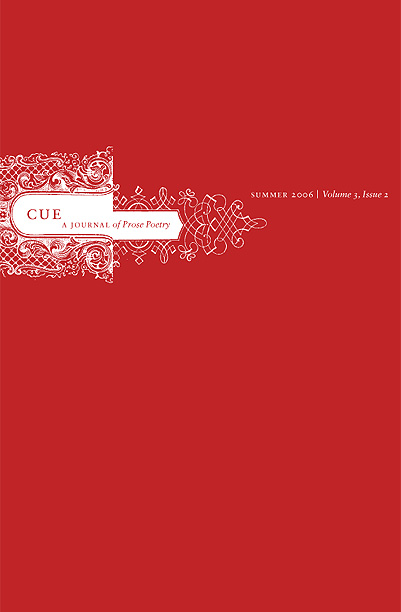
CUE5
John Ashbery
Rosmarie Waldrop
Campbell McGrath
Boyer Rickel
Michael Schiavo
Peter Jay Shippy
Joshua Marie Wilkinson
Christoph Casamassima
Michael Rerick
Steve Timm
& two prose poems by Angel Crespo, translated from the Spanish by Steven J. Stewart
We've still got some back issues of CUE we'd like to find homes for. Check out our subscription page for details.
Thursday, September 07, 2006
Tucson Poetry Round-up
Some up-coming readings:
University of Arizona Poetry Center
presents Albert Goldbarth
Tonight, Thurs. Sept 7, 8pm
at Modern Languages Auditorium
WIP Reading
U of A grad students Jamie Poissant, Peter Derby, Lauren Eggert-Crowe
7pm Friday, Sept. 8
at Casa Libre, located on the east side of 4th Ave., between 8th and 9th streets
Cushing Street Poetry (sponsored by Chax Press and POG)
a reading by Sue Carnahan & Aarcon Cohick
8pm, Tuesday, Sept. 12
at Cushing Street Bar and Restaurant, on the patio
198 W. Cushing St.
For an update on development plans for the Tucson Historic Warehouse Arts District, check out the Chax blog. The news doesn't sound promising.
Also, if you've contributed to CUE and you're going to be in Atlanta for AWP, CUE and Casa Libre are putting together a reading. If you're interested, the details are over at Steph's blog.
University of Arizona Poetry Center
presents Albert Goldbarth
Tonight, Thurs. Sept 7, 8pm
at Modern Languages Auditorium
WIP Reading
U of A grad students Jamie Poissant, Peter Derby, Lauren Eggert-Crowe
7pm Friday, Sept. 8
at Casa Libre, located on the east side of 4th Ave., between 8th and 9th streets
Cushing Street Poetry (sponsored by Chax Press and POG)
a reading by Sue Carnahan & Aarcon Cohick
8pm, Tuesday, Sept. 12
at Cushing Street Bar and Restaurant, on the patio
198 W. Cushing St.
For an update on development plans for the Tucson Historic Warehouse Arts District, check out the Chax blog. The news doesn't sound promising.
Also, if you've contributed to CUE and you're going to be in Atlanta for AWP, CUE and Casa Libre are putting together a reading. If you're interested, the details are over at Steph's blog.
Wednesday, September 06, 2006
Poetry Magazine
If its author John Barr (admitted president of the Poetry Foundation and former board member of the Poetry Society of America, Yaddo and Bennington College) didn't take himself half so seriously, one might expect to see his essay, "American Poetry in the New Century", lampooned in the back pages of Poetry's annual "humor issue." As it appears this month, however, the essay (not at all intended to be a tounge-in-cheek send up of anything) reminds one just how easy it's become to laugh at any issue of Poetry, especially when the editors court such ridicule themselves, presuming, as they do, that Poetry retains any kind of aesthetic credibility among those writers it ostensibly wants to instigate into new heights of creative fervor.
A glance at any recent issue confirms how as a platform the magazine is defunct, how in its aesthetic taste decrepid, and has been since at least the 1960's. As if the work in the September issue weren't bad enough (Kevin McFadden and D.A. Powell appear to be the only exceptions), Barr's naive missive might just be the most convoluted pseudo-manifesto-ing Poetry has ever had the obligation to publish. Full of the same lamenting after lost accessibility, the same re-tread schtick about the blight of MFA programs on originiality, and the same old pining after those great days of yore when insurance executives and pediatricians could hold down a job AND re-invent American poetry, one wonders if this is the best PR $150 million dollars can buy.
Barr's thesis: "The manner of [modern poetry] has long been mastered. Modernism has passed into the DNA of the MFA programs. For all its schools and experiments, contemporary poetry is still written in the rain shadow thrown by Modernism. It is the engine that drives what is written today. And it is a tired engine."
Tired, certainly. Nearly as tired as Barr's contradictory posture. Indeed, for an essay concerned with contemporary American poetry's aesthetic laziness (its reliance on Modernist models), this essay indulges the very same laziness it purports to decry. Sadly it's an irony lost on Mr. Barr. Eliot, Stevens, Moore, Williams, Stein, Pound, Frost--each is dished up as a quick quip or easy anecdote, and all in a sappy, self-satisfied tone.
Wanna inspire your poetry, dear writer? Stop worrying about your credentials and follow Ernest Hemingway's example--"live more . . . write better."
How else but as stunningly naive can one describe Barr's essay when, with a straight face and in all earnestness, he asks "Will the next Walt Whitman be an MFA graduate?" Or when we stumble across such hackneyed new-age-isms like this: "Poetry, like a prayer book in the wind, should be open to all pages at once."
Perhaps the most disturbing of Barr's contentions is his belief that poetry must be more entertaining, saying so first in relation to MFA programs: "The effect of these programs on the art form is to increase the abundance of poetry, but to limit its variety. The result is poetry that is neither robust, resonant, nor--and I stress this quality--entertaining . . ." And later, in relation to poetry's wider cultural relevance: "The human mind is a marketplace, especially when it comes to selecting one's entertainment . . ."
If Barr, instead of skimming its surface mythologies, had delved a bit deeper into literary history, he might have remembered how much of what is now considered Modern was, in its time, defiantly erudite, wilfully challenging. That is, the very writers he today reveres aspired to be anything but entertainment back in the day.
If only Barr shared such aspirations . . .
~~~~~~~~~~~~~~~~~~~~~~~~~~~~~~~~~~~~~~~
Matthew takes issue with the essay over at his blog.
A glance at any recent issue confirms how as a platform the magazine is defunct, how in its aesthetic taste decrepid, and has been since at least the 1960's. As if the work in the September issue weren't bad enough (Kevin McFadden and D.A. Powell appear to be the only exceptions), Barr's naive missive might just be the most convoluted pseudo-manifesto-ing Poetry has ever had the obligation to publish. Full of the same lamenting after lost accessibility, the same re-tread schtick about the blight of MFA programs on originiality, and the same old pining after those great days of yore when insurance executives and pediatricians could hold down a job AND re-invent American poetry, one wonders if this is the best PR $150 million dollars can buy.
Barr's thesis: "The manner of [modern poetry] has long been mastered. Modernism has passed into the DNA of the MFA programs. For all its schools and experiments, contemporary poetry is still written in the rain shadow thrown by Modernism. It is the engine that drives what is written today. And it is a tired engine."
Tired, certainly. Nearly as tired as Barr's contradictory posture. Indeed, for an essay concerned with contemporary American poetry's aesthetic laziness (its reliance on Modernist models), this essay indulges the very same laziness it purports to decry. Sadly it's an irony lost on Mr. Barr. Eliot, Stevens, Moore, Williams, Stein, Pound, Frost--each is dished up as a quick quip or easy anecdote, and all in a sappy, self-satisfied tone.
Wanna inspire your poetry, dear writer? Stop worrying about your credentials and follow Ernest Hemingway's example--"live more . . . write better."
How else but as stunningly naive can one describe Barr's essay when, with a straight face and in all earnestness, he asks "Will the next Walt Whitman be an MFA graduate?" Or when we stumble across such hackneyed new-age-isms like this: "Poetry, like a prayer book in the wind, should be open to all pages at once."
Perhaps the most disturbing of Barr's contentions is his belief that poetry must be more entertaining, saying so first in relation to MFA programs: "The effect of these programs on the art form is to increase the abundance of poetry, but to limit its variety. The result is poetry that is neither robust, resonant, nor--and I stress this quality--entertaining . . ." And later, in relation to poetry's wider cultural relevance: "The human mind is a marketplace, especially when it comes to selecting one's entertainment . . ."
If Barr, instead of skimming its surface mythologies, had delved a bit deeper into literary history, he might have remembered how much of what is now considered Modern was, in its time, defiantly erudite, wilfully challenging. That is, the very writers he today reveres aspired to be anything but entertainment back in the day.
If only Barr shared such aspirations . . .
~~~~~~~~~~~~~~~~~~~~~~~~~~~~~~~~~~~~~~~
Matthew takes issue with the essay over at his blog.
Friday, September 01, 2006
Rhetoric
Over the past few months a shift in rhetoric has occured among those who would, to their last tooth and nail, defend our incursion into Iraq, Israel's overzealous invasion of Lebanon and the broader war against Islamic fundamentalists. Co-opting the aura of moral clarity that ostensibly motivated America to fight in WWII, the Bush administration and its lackeys have been conspicuously drawing comparisons between America's involvement in that second world war and our current global "war against terror." Some pundits in the media have even (and almost gleefully) taken to dubbing (or dubya-ing ) it World War III, perhaps hoping that by saying so will instigate the Rapture and Christ's second coming.
Indeed, it was just a few days ago that the inimitably quixotic Mr. Rumsfeld likened those who oppose his failed policies in Iraq to those who, in the late 1930's, sympathized with German fascism and who, later, advocated the appeasement of Adolf Hitler. According to Rumsfeld, those who wonder ever loudly why we're still in Iraq just "seem not to have learned history's lessons."
It's a dangerous time we live in when those who fabricate a war can, in defense of it, toss off such hypberolic rhetoric without ever fearing the kind of meaningful confrontation by journalists that would not only call into question such gross exagerations of the historical record, but that would also, hopefully, begin to restore some scale to the debate and its context.
Keith Olberman may have begun something yesterday when, in what amounted to a channeling of the spirit of one Edward R. Murrow, delivered a much needed chiding to Rumsfeldian logic. Check it out...
Indeed, it was just a few days ago that the inimitably quixotic Mr. Rumsfeld likened those who oppose his failed policies in Iraq to those who, in the late 1930's, sympathized with German fascism and who, later, advocated the appeasement of Adolf Hitler. According to Rumsfeld, those who wonder ever loudly why we're still in Iraq just "seem not to have learned history's lessons."
It's a dangerous time we live in when those who fabricate a war can, in defense of it, toss off such hypberolic rhetoric without ever fearing the kind of meaningful confrontation by journalists that would not only call into question such gross exagerations of the historical record, but that would also, hopefully, begin to restore some scale to the debate and its context.
Keith Olberman may have begun something yesterday when, in what amounted to a channeling of the spirit of one Edward R. Murrow, delivered a much needed chiding to Rumsfeldian logic. Check it out...
Tuesday, August 29, 2006
George Carlin
"I'm a modern man, a man for the millennium, digital and smoke-free, a diversified multi-cultural post-modern deconstructionist, politically, anatomically, and ecologically incorrect. I've been uplinked and downloaded, I've been inputted and outsourced, I know the upside of downsizing, I know the downside of upgrading. I'm a high-tech lowlife, a cutting edge state-of-the-art bi-coastal multitasker, and I can give you a gigabyte in a nanosecond. I'm new wave, but I'm old school, and my inner child is outward bound. I'm a hot-wired, heat-seeking, warm-hearted cool customer, voice-activated and biodegradable. I interface with my database, and my database is in cyberspace, so I'm interactive, I'm hyperactive, and from time to time, I'm radioactive. Behind the 8-ball, ahead of the curve, riding the wave, dodging the bullet, pushing the envelope. I'm on point, on task, on message, and off drugs. I got no need for coke and speed. I have no urge to binge and purge. I'm in the moment, on the edge, over the top, but under the radar. A high-concept, low-profile, medium-range ballistics missionary. A street-wise smart bomb, a top-gun bottom-feeder. I wear power ties, I tell power lies, I take power naps, I run victory laps. I'm a totally ongoing bigfoot slamdunk rainmaker with a proactive outreach. A raging workaholic, a working rageaholic, out of rehab and in denial. I got a personal trainer, a personal shopper, a personal assistant, and a personal agenda. You can't shut me up, you can't dumb me down, 'cause I'm tireless, and I'm wireless. I'm an alphamale on beta blockers. I'm a non-believer and an overachiever, laid back, but fashion forward, up front, down home, low rent, high maintenance; super size, long lasting, high definition, fast acting, oven ready, and built to last. I'm a hands-on, footloose, kneejerk headcase, prematurely post-traumatic, and I have a love child who sends me hate mail. But I'm feeling, I'm caring, I'm healing, I'm sharing, a supportive, bonding, nurturing, primary caregiver. My output is down, but my income is up. I take a short position on the long bond, and my revenue stream has its own cash flow. I read junk mail, I eat junk food, I buy junk bonds, I watch trash sports. I'm gender specific, capital intensive, user friendly, and lactose intolerant. I like rough sex, I like tough love, I use the F-word in my e-mails, and the software on my hard drive is hardcore, no soft porn. I bought a microwave at a minimall, I bought a minivan at a megastore, I eat fast food in the slow lane. I'm tollfree, bite size, ready to wear, and I come in all sizes. A fully equipped, factory authorized, hospital tested, clinically proven, scientifically formulated medical miracle. I've been prewashed, precooked, preheated, prescreened, preapproved, prepackeged, postdated, freeze dried, double wrapped, vacuum packed, and I have an unlimited broadband capacity. I'm a rude dude, but I'm the real deal, lean and mean, cocked, locked, and ready to rock; rough, tough, and hard to bluff. I take it slow, I go with the flow, I ride with the tide, I got glide in my stride. Drivin' and movin', sailin' and spinnin', jivin' and groovin', wailin' and winnin'. I don't snooze, so I don't lose. I keep the pedal to the metal and the rubber on the road. I party hardy, and lunch time is crunch time. I'm hangin' in, there ain't no doubt, and I'm hangin' tough, over and out."
Monday, August 28, 2006
Deadwood Finale
It's only fitting that the best show on television, Deadwood, should have its season finale on the same night that television, bereft of any aesthetic or literary conscience, celebrates (in such maudline fasion, too) the life's "work" of Aaron Spelling, the man responsible for such mindless fare as Charlie's Angels, Fantasy Island, and Dynasty, and who, as an actor in or writer for Gunsmoke, Wagon Train, and Zane Gray Theatre, had a hand in the very Western myth-making of the late 50's and early 60's that Deadwood has mercilessly deconstructed over the past three seasons.
I know I shouldn't be surprised how mediocrity triumphed over artistry, the pedestrian over originality, but really . . . just take a look at the winners. Putting aside (or at least trying to) the new Emmy "rules" that would snub Deadwood in all categories . . .
24 over The Sopranos for Best Drama? The Office over Curb Your Enthusiasm, or Arrested Development for Best Comedy seires? Tony Shaloub winning his third Emmy over Larry David?! That's just wrong . . .
Three bright bright spots: The Daily Show picking up two more statues, Jeremy Piven FINALLY winning for Entourage and the nod for best supporting actor to the inimitable Alan Alda who almost single-handedly resuscitated the last two seasons of The West Wing.
And is there anyone funnier than Conan O'Brien? If you haven't seen the opening sketch, it's absolutely hilarious. He spoofs those ubiquitous Dateline on-line pedophilia stings. Absolutely brilliant . . .
I know I shouldn't be surprised how mediocrity triumphed over artistry, the pedestrian over originality, but really . . . just take a look at the winners. Putting aside (or at least trying to) the new Emmy "rules" that would snub Deadwood in all categories . . .
24 over The Sopranos for Best Drama? The Office over Curb Your Enthusiasm, or Arrested Development for Best Comedy seires? Tony Shaloub winning his third Emmy over Larry David?! That's just wrong . . .
Three bright bright spots: The Daily Show picking up two more statues, Jeremy Piven FINALLY winning for Entourage and the nod for best supporting actor to the inimitable Alan Alda who almost single-handedly resuscitated the last two seasons of The West Wing.
And is there anyone funnier than Conan O'Brien? If you haven't seen the opening sketch, it's absolutely hilarious. He spoofs those ubiquitous Dateline on-line pedophilia stings. Absolutely brilliant . . .
Friday, August 25, 2006
CUE News
We're starting to put together the 5th issue of CUE which we hope to have out no later than the first week of October.
~
Received in the mail today a giant sheef of poems from Campbell McGrath. One of the first prose poets I ever really loved. This new work doesn't disappoint.
~
A new website is in the works. One that doesn't piggy-back off of my arizona server space.
~
Received in the mail today a giant sheef of poems from Campbell McGrath. One of the first prose poets I ever really loved. This new work doesn't disappoint.
~
A new website is in the works. One that doesn't piggy-back off of my arizona server space.
Sunday, August 20, 2006
Free, Free at Last!
I'm out of the hospital and kickin some serious poetry ass. A new poem that's pretty much finished, and I found out yesterday that NoTell Motel has accepted a poem for its second incarnation of The Bedside Guide, due out this january. More soon...
Monday, August 14, 2006
News
Octopusbooks has selected its first 8 chapbooks. Zach has also handed out some honorable mentions that are verrrrry interesting...
Tuesday, August 08, 2006
Violence and Poetry 2
Sitting in here, surrounded by sick people and doctors who look through us rather than at us, I've been thinking again about violence and poetry. Violence and my poetry, to be exact. It's got me thinking about what I want out of my work, which, I think, is what both Hopkins and Bacon wanted from their art--that is to play the nerve ends. Both (and this comes more from Bacon's mouth than mine) wanted an art, or at least the possibility of an art (a method perhaps) that shoots straight for the senses, doing away with the boredom of conveyance. An assault upon the nervous system is how, I think, Bacon put it, though of course working with paint obviously has the greater advantage in terms of immediacy.
What I want from my own work comes down to this: to speak at once both brokenly and reparably. Thus, the need for a language that gropes and grinds, thus the need for an aggravated language full of contraversions of sense and syntax. I've been reading Celan again and have come to realize in his work a kindred poetics. This is by no means meant to imply I can understand the absolute terrors of his life, as profound and, ultimately, unendurable as they were. To have one's language implicated in the the mass extermination of an entire people is nearly unfathomable. But his need to go after language, to wrench it, wrestle it, to put his knee on its neck and go through it is as admirable as it is excitingly scary. That kind of brilliant and afflicted invention amazes me. As Celan put it, I'm looking for a language "wounded by and seeking reality." Hopkins, too, has his say; he speaks of a language "tonguetrue, vaunt- and tauntless."
So all that concussing, all the invention and retro-fitting that I want to do in my work needs to represent a rescuing of breath from suffocation as much as it is an attempt, too, to overwhelm the reader, to leave him breathless. Ideally I want the poems to work with air and its absence, joy and lust and headfirst-ness, and everything that is counterpoint to that.
On a not completely unrelated side-note, I think I need to read more Olson. Are there any on-line versions of "Proprioception" out there? And what about his essay on projective verse? Oh, and while I'm at it, is there anywhere I can find an on-line version of Call Me Ishmael?
On a not completely unrelated side-note, I think I need to read more Olson. Are there any on-line versions of "Proprioception" out there? And what about his essay on projective verse? Oh, and while I'm at it, is there anywhere I can find an on-line version of Call Me Ishmael?
Saturday, August 05, 2006
Priest of the Imagination
"This is what you shall do: Love the earth and sun and the animals, despise riches, give alms to every one that asks, stand up for the stupid and crazy, devote your income and labor to others, hate tyrants, argue not concerning God, have patience and indulgence toward the people, take off your hat to nothing known or unknown or to any man or number of men, go freely with powerful uneducated persons and with the young and with the mothers of families . . . re-examine all you have been told at school or church or in any book, dismiss whatever insults your own soul, and your very flesh shall be a great poem and have the richest fluency not only in its words but in the silent lines of its lips and face and between the lashes of your eyes and in every motion and joint of your body . . . . . . . . . . . The poet shall not spend his time in unneeded work . . . What balks or breaks others is fuel for his burning progress to contact and amorous joy . . . he leaves room ahead of himself."
-WW
-WW
Friday, August 04, 2006
Saturday, July 29, 2006
Elliptical Poetry 2
Thank you to Sue Carnahan for pointing out the following essay on elliptical poetry. Even though the term has been around--as I found out today--for nearly 10 years, I'd only vaguely registered its coinage until recently when it confronted me in a letter from a former professor of mine who labeled the work in Verge, my first manuscript, as such. For those of you who are smarter and more well-read than I, I hope you'll forgive this belated curiousity and, should you have any other leads in this direction, that you'll share them.
Shearing Away
by Stephen Burt
Stephen Dobyns' best poem shows a man and dog staring into a refrigerator at dawn, looking for "answers to what comes next, and how to like it". Young American poets seeking such answers face an exciting, if a cluttered, field. James Merrill is no longer with us (though his followers are); John Ashbery is everywhere, and is perhaps now too prolific; and Jorie Graham has become an unavoidable presence in other people's styles, partly because she teaches at Iowa and gets lots of press, but mostly because her cinematic, intellective The End of Beauty (1987) established her as her generation's best poet. The most exciting younger poets have read Graham and do not imitate her; they share goals and tones and attitudes, and the best way to explain what they share is, I fear, to coin a term for a school. I therefore introduce the Elliptical Poets. I made up the school, but all the books are real; most still await UK publishers.
Elliptical Poets are always hinting, punning or swerving away from a never-quite-unfolded backstory; they are easier to process in parts than in wholes. Elliptics seek the authority of the rebellious; they want to challenge their readers, violate decorum, surprise or explode assumptions about what belongs in a poem, or what matters in life, and to do so while meeting traditional lyric goals. Their favorite attitudes are desperately extravagant, or tough-guy terse, or defiantly childish: they don't believe in, or seek, a judicious tone. Elliptical poets like insistent, bravura forms, and forms with repetends - sestinas, pantoums, or fantasias on single words, like Liam Rector's 'Saxophone':
You and I, our money. Their money.
Our pleasure and fist full of money.
Laughter over money, serious money,
over money. Too much, too little,
fluid money. The saxophone, color of wheat,
purchased through Hock Shop money, saxophone
splitting the night, our air, blowing money.
Rector's The Sorrow of Architecture (1984) may be the first Elliptical book. Rector's anger stems from his Brechtian interest in work, debt and wages, in "the ongoing circulation / Of art and money... the hunger, // The hunt, the eat". He may have invented the fractured sestina forms that pervade poems like 'Driving November', a three-page work with the proportionate strength of a crime-spree film:
We are driving November we turned
October several towns back. We applaud
the passing of all that is innocent we inherit
the road as it is here. You speak of habit
as if things do not change I speak
of sweet repetition. We are driving November, from harm.
Ellipticals love poems that declare "I am X, I am Y, I am Z", where X, Y and Z are incompatible things. Mark Levine, who specializes in such poems, also shares Rector's interests in money, locality and work. Levine's debut Debt (1993) is Ellipticism at its most aggressive, rife with allusion and disillusion. His punky 'Work Song' proves him Berryman's legatee:
I am Henri, mouth full of soda crackers.
I live in Toulouse, which is a piece of cardboard.
Summers the Mayor paints it blue, we fish in it.
Winters we skate on it. Children are always
drowning or fallling through cracks. Parents are distraught

but get over it. It's easy to replace a child.
Like my parents' child, Henri.
Elliptical poets create inversions, homages, takeoffs on old or "classic" poems; they also adapt old subgenres - aubade, elegy, verse-letter, and especially ode. Almost all write good prose poems. Lucie Brock-Broido is the most ambitious, most tradition- conscious Elliptical. Her The Master Letters (1995) quarries Dickinson, Donne, Romeo and Juliet; exclaims "I am angel, addict, catherine wheel - a piece of work / On fire"; specifies, "At your feet I am a shoemaker's apprentice, / Toxic in a long day of fumes"; entitles a poem 'You Can't Always Get What You Want', and opens it with backtalk from Lolita: "Light of your loins - I have been to the ruins & come back with art". Her prose poems boast menageries of similes - "senseless as crates of fish stacked glimmering, one-eyed & blank, one atop the other of them"; the best of her many personae may be Anne Boleyn, in a poem called (after Wyatt) 'And Wylde for to Hold':
Lack of water, lack of light,
Lack of heat, lack of bedding, I should go
On this way forever; it is
my wont to go.
Tonight - the wind will
be high in its scaffolding,On the strength. I will
listen for its habit
Especially about
the throat like an
Elizabethan cuffAt the crude nest of the
mouth. Our bed
Will be lined with shred-
ded bark from sycamore
& hair.Let them lie broad awake
in their nest, scissoring.
None will fly.
Ellipticals caress the technical; there is, as Rebecca Reynolds puts it, "less / she can touch now / that isn't technical and reluctant". They mix their affections with alienations. Susan Wheeler's Smokes (1998) presents her sometimes as a movie star, sometimes as a "hapless stand-in scripter" with an "impedimented personality", fleeing or seeking love or fame. She makes leaps from low to high diction; likes to interrupt herself; writes "I am X, I am Y" poems; and mixes up old high allusions with TV and Barbies. Her talent lies in her kidnapping of familiar forms, as in 'Shanked on the Red Bed' (an update, perhaps, of MacNeice's 'Bagpipe Music'):
The century was breaking and the blame was on default,
The smallest mammal redolent of what was in the vault,
The screeches shrill, the ink-lines full of interbred regret -
When I walked out to look for you the toad had left his net.
The discourse flamed, the jurors sang, the lapdog strained his leash -
When I went forth to have you found the tenured took the beach
With dolloped hair and jangled nerves, without a jacking clue,
While all around the clacking sound of polished woodblocks blew.
August Kleinzahler is Elliptical in his all-inclusiveness, his casual refusals of authority, his jarring jumps from elevation to slang. Kleinzahler's wry, Californian cadences can encompass anything he sees or hears - the sun from a plane, headlines, Thom Gunn, dogwoods, crisps, DTs. A ballet he watches prompts 'Sapphics in Traffic', which begins, "Festinating rhythm's bothered her axis"; where Larkin wrote 'Lines on a Young Lady's Photograph Album', Kleinzahler writes the semi-rhymed, half-nostalgic quatrains of 'Ruined Histories':
Ah, Little Girl Destiny, it's sprung a leak
and the margins are bleeding themselves away.
You and I and the vase and stars won't stay still.
Wild, wild, wild - kudzu's choked the topiary.
Looks like your history is about to turn
random and brutal, much as an inch of soil or duchy.
Not at all that curious hybrid you had in mind.
Jane Austen, high-tech and a measure of Mom.
Like the Eliot of 'Prufrock', or the Berryman of The Dream Songs, the Ellipticals delete their transitions: one thought, one impression, tailgates another. C. D. Wright is expert at laying down a series of hints, or residues, of experience, making readers discover what happened. Wright began publishing in the late 1970s, but her best books are recent: her first fully Elliptical work is String Light (1991), full of detailed tenderness for, and scorched regret about, her native Arkansas. She, too, has a rebellious "I" poem, 'Personals':
In this humidity I make repairs by night. I'm not one
among many who saw Monroe's face
in the moon. I go blank looking at that face.
If I could afford it I'd live in hotels. I won awards
in spelling and the Australian crawl. Long long ago.
Grandmother married a man named Ivan. The men called him
Eve. Stranger, to tell the truth, in
                                                 dog years I am up there.
Wright's technique of hinting allows her in Tremble (1996) to make terse, radiant sketches of bodily, erotic histories, 'Key Episodes from an Earthly Life': the poem of that name begins "As surely as there are crumbs on the lips / of the blind I came for a reason". It ends:
Around this time of year     especially evening
I love everything     I sold enough eggs
To buy a new dress I watched him drink the juice
Of our beets And render the light liquidI came to talk you into physical splendor
I do not wish to speak to your machine
Thylias Moss is Ellipticism at its most tonally risky, and socially conscious: her registers include Blakean outrage, African-American preaching cadences, and the disarming backtalk of kids. Moss swerves between wisecracks and credos: her uneasy speakers, girls and adults, ground their defiance in local events, as in 'When I Was 'Bout Ten We Didn't Play Baseball':
           It's hot. We might
sleep on the porch. Next year we really will have it
screened so we won't ever have to respect mosquitos
again. I listen to all the emergencies,
sirens of course, the Cadillac horns of the wedding, a mother
new to the area calling home her children
forgetting not to call the names of the ones who don't
come home anymore on nights like these when all it has to be
is summer and they're cared for better. The heat does hug.
It isn't shy and proper. My mother wouldn't want me
to play with it.
Moss favors jangly linebreaks and swift tonal shifts, Kleinzahler his slang-slinging, Brock-Broido her extravagance, because these poets want to make poems as volatile as real life. So do their peers. Most Ellipticals are between 30 and 50, and found their real styles after 1986. If they have a geographical center, it's New York City (though several have taught, or studied, at the University of Michigan). Ellipticals invoke, as precedents, Dickinson, Berryman, Ashbery, sometimes Auden; they read New American Writing, Denver Quarterly, Conjunctions, Parnassus, Boston Review. All want to convey both metaphysical challenge, and recognizable, seen or tasted, detail. Ellipticism rejects: poems written in order to demonstrate theories; prettiness as its own end; slogans; mysticism; and straight-up narrative. Ellipticals are uneasy about (less often, hostile to) inherited elites and privileges, but they are not populists, and won't write down to, or connect the dots for, their readers; their difficulty conveys respect.
Time will find and polish the best Elliptical verse, as it has with prevailing styles from the Tribe of Ben to the allies of Auden. I wish I had space to quote from the bedazzled, lyrical prose poet Killarney Clary; Forrest Gander's careful sequences; Karen Volkman's exceptional, varied debut Crash's Law; April Bernard's jittery Blackbird Bye Bye; Rebecca Reynolds' first book, Daughter of the Hangnail; the comic, tender, botanizings of Alice Fulton; and the Ellipticals' overseas counterparts, Australia's John Tranter, who often visits the USA, and Britain's Mark Ford. For now, these uneasy, echt contemporary, difficult American poets have written a heap of at-least-pretty-good poems. Vaunting or angry, precise but not pedantic, hip but rarely jaded, they are in all the best (and a few worse) senses, what comes next.
Friday, July 28, 2006
Tuesday, July 25, 2006
Monday, July 24, 2006
Deadwood
Of the twenty-four Swearengen quotes Michael has posted over at his blog, here is my favorite thus far:
"Pain or damage don’t end the world, or despair, or fuckin’ beatings. The world ends when you’re dead. Until then, you got more punishment in store. Stand it like a man—and give some back."
Somehow, I think, this statement fits into my notion of the poetics of violence, but I haven't yet fully assimilated it.
On a side-note, I'm feeling like this season of Deadwood is much more distended in terms of its plot than the past two. Aside from the first episode and the brilliantly gorey Dan Dority fight three weeks ago, the season has felt something like one long suspended set-up for the finale--perhaps because I recently watched the first two seasons on DVD over the span of less than two weeks. This isn't a bad thing, but it's hard to see where all the story-lines are headed. I'm purposely avoiding the historic record for insight.
"Pain or damage don’t end the world, or despair, or fuckin’ beatings. The world ends when you’re dead. Until then, you got more punishment in store. Stand it like a man—and give some back."
Somehow, I think, this statement fits into my notion of the poetics of violence, but I haven't yet fully assimilated it.
On a side-note, I'm feeling like this season of Deadwood is much more distended in terms of its plot than the past two. Aside from the first episode and the brilliantly gorey Dan Dority fight three weeks ago, the season has felt something like one long suspended set-up for the finale--perhaps because I recently watched the first two seasons on DVD over the span of less than two weeks. This isn't a bad thing, but it's hard to see where all the story-lines are headed. I'm purposely avoiding the historic record for insight.
Sunday, July 23, 2006
CUE News
A big welcome and much thanks to Michael Schiavo who's agreed to join the editorial board of CUE.
~
CUE has received a substantial grant from the Arizona Commission on the Arts. This should allow us to re-vamp our website, advertise, and grow the magazine. Thanks, Arts Commission.
~
Jason Zuzga, non-fiction editor for Fence, will edit Issue 6 of CUE.
~
CUE has received a substantial grant from the Arizona Commission on the Arts. This should allow us to re-vamp our website, advertise, and grow the magazine. Thanks, Arts Commission.
~
Jason Zuzga, non-fiction editor for Fence, will edit Issue 6 of CUE.
Thursday, July 20, 2006
Stuff
Let's hear if for our "pro-life," compassionate-conservative President. Using his first veto of his entire presidency, he said no to science, to the sick, and to common sense.
~
Shampoo has accepted three of my poems for Issue 28.
~
After months of raising a dry bucket, I've finally got a new poem started.
~
I head back to Tucson on saturday, at which time A Peek of Reach will resume its regularly schedueled programming.
~
Shampoo has accepted three of my poems for Issue 28.
~
After months of raising a dry bucket, I've finally got a new poem started.
~
I head back to Tucson on saturday, at which time A Peek of Reach will resume its regularly schedueled programming.
Tuesday, July 04, 2006
Violence and Poetry
I've been thinking lately about violence in relation to language. Not the mere description of violent acts, but rather the violation (or intentional wrenching, distorting, distending) of linguistic norms and procedures--be they syntactical, grammatical, typographical--through which an internalized bodily vulnerability or fragility may emerge. I got to thinking of this relation between violence and art because recently I found an old notebook kept during my infatuation with the painter Francis Bacon. Here are a few Bacon quotes I re-discovered that may give you some sense of what I mean:
"I think of myself as a kind of pulverizing machine into which everything I look at and feel is fed."
"If you're in love you can't break down the barriers of the skin."
"In a painting that's even worth looking at, the image must be twisted if it is to make a renewed assault on the nervous system."
"If I go to a butcher's shop I always think it's surprising that I wasn't there instead of the animal."
Also mingled throughout the notebook are a few passages lifted from Vendler's The Breaking of Style and, in particular, the chapter on Hopkins, wherein she suggests "[Hopkins] succeeded in breaking up, by a kind of creative violence, an outworn convention. He led poetry forward by taking it back to its primal linguistic origins."
Taking up the peculiarities of Hopkins' poetic rythems, Vendler continues: "One could say that the spondees represent the impression of a poet who receives the stimuli of daily life as a series of unforseeable and unsettling assaults. The regular measures of ordinary verse simply did not seem to Hopkins to represent the felt texture of his experience, which was counter, original, spare, strange." In this sense, Hopkins' poetry becomes a mimetic reaction to "a universe of continual irregular shocks in which the normal expectable motions of physical law--from peacable alterations of day and night to reassuringly identical repetitions of iambs--have been replaced by an unpredictable series of unforseen impulses."
It's this last quote that gets me--"irregular shocks" and "peacable alterations." I think of these things in relation to Cystic Fibrosis, which itself is "an unpredictable series of unforseen impulses," and which brings me back to this same aesthetic quetion: Can a body so aware of itself and its physical defects harness the intensities of sound and sound textures in order to convey the physical abruptness of its own violent processes? Or is it always just an approximation, something there merely on the surface?
"I think of myself as a kind of pulverizing machine into which everything I look at and feel is fed."
"If you're in love you can't break down the barriers of the skin."
"In a painting that's even worth looking at, the image must be twisted if it is to make a renewed assault on the nervous system."
"If I go to a butcher's shop I always think it's surprising that I wasn't there instead of the animal."
Also mingled throughout the notebook are a few passages lifted from Vendler's The Breaking of Style and, in particular, the chapter on Hopkins, wherein she suggests "[Hopkins] succeeded in breaking up, by a kind of creative violence, an outworn convention. He led poetry forward by taking it back to its primal linguistic origins."
Taking up the peculiarities of Hopkins' poetic rythems, Vendler continues: "One could say that the spondees represent the impression of a poet who receives the stimuli of daily life as a series of unforseeable and unsettling assaults. The regular measures of ordinary verse simply did not seem to Hopkins to represent the felt texture of his experience, which was counter, original, spare, strange." In this sense, Hopkins' poetry becomes a mimetic reaction to "a universe of continual irregular shocks in which the normal expectable motions of physical law--from peacable alterations of day and night to reassuringly identical repetitions of iambs--have been replaced by an unpredictable series of unforseen impulses."
It's this last quote that gets me--"irregular shocks" and "peacable alterations." I think of these things in relation to Cystic Fibrosis, which itself is "an unpredictable series of unforseen impulses," and which brings me back to this same aesthetic quetion: Can a body so aware of itself and its physical defects harness the intensities of sound and sound textures in order to convey the physical abruptness of its own violent processes? Or is it always just an approximation, something there merely on the surface?
Saturday, July 01, 2006
Documentary Recomendation
If you haven't seen Why We Fight, a relatively new documentary about the American war machine, put it at the top of your Netflix queue. Watch it, and then watch Triumph of the Will, Leni Reifenstahl's classic Nazi propaganda film which documents the 1934 Nuremberg Party Rally. The juxtaposition, while overtly pedagogical, will totally creep you out. Not that you need any reminding, but you'll realize immediately how we write in the shadows of an empire.
Among other things, the films called to mind this statement Charles Wright once made. No matter how you feel about his work, the guy's gotta hell of an ear for truth. Yes, truth.
"Poetry comes, for lack of better words, from the heart (the "foul rag-and-bone-shop of the heart," as Yeats had it), and from the soul—neither a place you can put your finger on, but a place you can surely put your foot in, if you don't watch out. It is a matter of "soul making," as John Keats said. It truly is not a matter of arrangement, of performance, of presentation, or rhetorical dazzle or surprise, though all of those matters may be part of it. It is not the distractions, but the focus. It is not the undercard, but the main event. There is always an emotional half to the equation, but the other half is always craft—you have to be able to say it your way. It's the only time that two plus one makes two—language is half, technique is half, and emotion is half. An emotional value is always involved. Distortions and side events are often interesting and entertaining, but they are not the stillness and fathered attention at road's end. It's not a question of paper, or type-writers, of white space or of dark space—it's a question of what's in your life, and where you want that life to lead you. You've only got one, and you can fill it with whatever you want. You're free and American. But if it is poetry that you want, then don't look for language games, intellectual rip-offs, or rhetorical sing-alongs. It's too often been a matter of life and death to those who really cared. You've got to know, in your heart of hearts, that Keats is right, that it is about soul-making, that it does matter, and that it can make you or break you as a person. It is the main event, as I say, and ancillary to nothing. It's either Atonement or At Onement, but it is one of them."
Is it enough to be an artist and to align one's self with the powers of creation? I used to think so. I'm no longer so sure.
Among other things, the films called to mind this statement Charles Wright once made. No matter how you feel about his work, the guy's gotta hell of an ear for truth. Yes, truth.
"Poetry comes, for lack of better words, from the heart (the "foul rag-and-bone-shop of the heart," as Yeats had it), and from the soul—neither a place you can put your finger on, but a place you can surely put your foot in, if you don't watch out. It is a matter of "soul making," as John Keats said. It truly is not a matter of arrangement, of performance, of presentation, or rhetorical dazzle or surprise, though all of those matters may be part of it. It is not the distractions, but the focus. It is not the undercard, but the main event. There is always an emotional half to the equation, but the other half is always craft—you have to be able to say it your way. It's the only time that two plus one makes two—language is half, technique is half, and emotion is half. An emotional value is always involved. Distortions and side events are often interesting and entertaining, but they are not the stillness and fathered attention at road's end. It's not a question of paper, or type-writers, of white space or of dark space—it's a question of what's in your life, and where you want that life to lead you. You've only got one, and you can fill it with whatever you want. You're free and American. But if it is poetry that you want, then don't look for language games, intellectual rip-offs, or rhetorical sing-alongs. It's too often been a matter of life and death to those who really cared. You've got to know, in your heart of hearts, that Keats is right, that it is about soul-making, that it does matter, and that it can make you or break you as a person. It is the main event, as I say, and ancillary to nothing. It's either Atonement or At Onement, but it is one of them."
Is it enough to be an artist and to align one's self with the powers of creation? I used to think so. I'm no longer so sure.
Monday, June 26, 2006
Saturday, June 24, 2006
Friday, June 23, 2006
Sound Poetry
For any number of reasons--not the least of which is the fact that it taught me how to violate language in my own work--the below poem is one of my favorites. And while, yes, it's a translation, it's still quite a ride.
Incantation by Laughter
by Velimir Khlebnikov transliterated by Gary Kern
O laugh it out, you laughsters!
O laugh it up, you laughsters!
So they laugh with laughters, so they laugherize delaughly.
O laugh it up belaughably!
O the laughingstock of the laughed upon–the laugh of
Belaughed laughsters!
O laugh it out roundlaughingly, the laugh of laughed-at
Laughians!
Laugherino, laugherino,
Laughify, laughicate, laugholets, laugholets,
Laughikins, laughikins,
O laugh it out, you laughsters!
O laugh it up, you laughsters!
According to Khlebnikov poetry aspires to zaum, what he describes as a "universal beyonsense." As Marjorie Perloff describes it in her book 21st Century Modernism: The "New" Poetics, zaum is based "less on 'non-sense' onomatopoeia than on elaborate etymology... phonemic and morphemic play" which can "produce a poetic language beyond (za) mind or reason (um)."
Incantation by Laughter
by Velimir Khlebnikov transliterated by Gary Kern
O laugh it out, you laughsters!
O laugh it up, you laughsters!
So they laugh with laughters, so they laugherize delaughly.
O laugh it up belaughably!
O the laughingstock of the laughed upon–the laugh of
Belaughed laughsters!
O laugh it out roundlaughingly, the laugh of laughed-at
Laughians!
Laugherino, laugherino,
Laughify, laughicate, laugholets, laugholets,
Laughikins, laughikins,
O laugh it out, you laughsters!
O laugh it up, you laughsters!
According to Khlebnikov poetry aspires to zaum, what he describes as a "universal beyonsense." As Marjorie Perloff describes it in her book 21st Century Modernism: The "New" Poetics, zaum is based "less on 'non-sense' onomatopoeia than on elaborate etymology... phonemic and morphemic play" which can "produce a poetic language beyond (za) mind or reason (um)."
Thursday, June 22, 2006
Avant-ness
Back in March I posted an excerpt from an interview with Dean Young in which he suggested that it's now all but impossible for any sort of meaningful (or fruitful) avant-garde to exist today. And yet this feeling is nothing new. Guess who wrote the following, and when?:
"Previously, vanguard artists never had to face the problems of integration into the art of their time because this usually happened at the end of a long career when the direction their art would take had long been fixed. When it took place earlier it could be dealt with by an explosition of bad temper, as in the possibly apocryhal story about Schonberg: when someone finally learned to play his violin concerto he stormed out of the concert hall, vowing to write another one that nobody would be able to play.
Today the avant-garde has come full circle--the artist who wants to experiment is again faced with what seems like a dead end, except that instead of creating in a vacuum he is now at the center of a cheering mob."
The answer is Ashbery. In 1968!
I'd like to raise the possibility that so much bland, over-determined poetry gets written today out of a fear of naivite. In the aftermath of the marriage between poetry and literary theory in the 70's and 80's, a marriage that's been playing out ever since, there's a palpable fear of NOT aspiring toward an intellectual poetry.
Or put it this way--a sculptor doesn't need to be a geologist in order to see the shape in the stone. Sensibility and intuition have a way of carrying us pretty damn far. Time for the pendulum to swing the other way.
More on this in future posts.
"Previously, vanguard artists never had to face the problems of integration into the art of their time because this usually happened at the end of a long career when the direction their art would take had long been fixed. When it took place earlier it could be dealt with by an explosition of bad temper, as in the possibly apocryhal story about Schonberg: when someone finally learned to play his violin concerto he stormed out of the concert hall, vowing to write another one that nobody would be able to play.
Today the avant-garde has come full circle--the artist who wants to experiment is again faced with what seems like a dead end, except that instead of creating in a vacuum he is now at the center of a cheering mob."
The answer is Ashbery. In 1968!
I'd like to raise the possibility that so much bland, over-determined poetry gets written today out of a fear of naivite. In the aftermath of the marriage between poetry and literary theory in the 70's and 80's, a marriage that's been playing out ever since, there's a palpable fear of NOT aspiring toward an intellectual poetry.
Or put it this way--a sculptor doesn't need to be a geologist in order to see the shape in the stone. Sensibility and intuition have a way of carrying us pretty damn far. Time for the pendulum to swing the other way.
More on this in future posts.
Sunday, June 18, 2006
TV
How much do I love HBO? A lot.
So I'll go ahead and say it--hands down, the best show on television is Deadwood.
So I'll go ahead and say it--hands down, the best show on television is Deadwood.
Saturday, June 17, 2006
New Mullen
I've been waiting for something like this--a collected of Mullen's three books from the 90's--Trimmings, S*PeRM**K*T and Muse & Drudge. Having started CUE years after the debut of Sleeping with the Dictionary, I now, finally, have an excuse to write on Mullen for the journal. It's a surprising publishing venture for Graywolf, an aesthetic departure of sorts for a press I, at least, think of as rather conservative. Nevertheless, I'm thrilled Recyclopedia--as it'll be called--will be available this fall.
Also coming in the fall: (especially for you, Mark) Lynda Hull's Collected Poems and Tony Hoagland's book of essays, Real Sofistikashun.
Crane Theory
So I finished the Clive Fischer biography of Hart Crane. As it is with Crane biographies, it was a wrenching experience, particularly toward the end when Crane's drinking--always heavy--takes on a life of its own.
But as far as biographies of Crane go, I still hold that the Paul Mariani bio, The Broken Tower, is the best read, if only for how much more time Mariani spends mulling over Crane's poems, especially The Bridge.
There was one Crane blurb (perhaps from a letter to Laura Riding, I'm not sure) that was particularly heartening:
"It is part of a poet's business to risk not only criticism--but folly--in the conquest of consciousness."
I love that. "Conquest" may be a bit strong, perhaps too militaristic for my taste, but I relate to the idea of risking folly. Risking something big in my writing. I guess because I'd rather be accused of over-indulgence than boredom.
But as far as biographies of Crane go, I still hold that the Paul Mariani bio, The Broken Tower, is the best read, if only for how much more time Mariani spends mulling over Crane's poems, especially The Bridge.
There was one Crane blurb (perhaps from a letter to Laura Riding, I'm not sure) that was particularly heartening:
"It is part of a poet's business to risk not only criticism--but folly--in the conquest of consciousness."
I love that. "Conquest" may be a bit strong, perhaps too militaristic for my taste, but I relate to the idea of risking folly. Risking something big in my writing. I guess because I'd rather be accused of over-indulgence than boredom.
Monday, June 05, 2006
Notes on the Ashbery Poem to Appear in CUE
Tonight I received a letter from John Ashbery, a follow up to the "prose poem" he was generous enough to pass along to CUE. First off, it's absolutely crazy to hold in my hands a piece of paper Ashbery took time to fold in thirds and place in an envelope. But high school crushes aside, included was a short note explaining the circumstances in which the text (which will appear in issue 5) was written. Below is the note--reproduced in full--as it will appear in CUE:
"This text was orginally written (in 2002) as part of a collaborative film project at the request of Yan Brailowsky, then a French diplomat living in New York. Five writers (Donald Breekenridge, Frederic-Yves Jeannet, Ron Padgett, John Yau, and Ashbery) were asked to 'contribute a maximum of one page of dialogue (and a minumum of one sentence)--"dialogue" being understood as "words uttered by at least one character." Each person has been proposed one of the five themes chosen: "yellow," "ears," "smiles," "food," and "little red book." Theme is a loose term you are welcome to interpret as you wish (after all, it's your dialogue.) [Ashbery's] theme would be "little red book."' It was also stipulated that the lines of dialogue could be used out-of-sequence."
Intriguing, yes. But here's the kicker:
"An initial script has been prepared, but the film has not yet been made. Brailowsky wants Ashbery to play the role of the Pope."
I laughed my ass of at that last part, trying to imagine Ashbery in one of those looming Pope hats...classic.
Publication in the same issue of CUE as Ashbery for anyone who writes a great prose poem that includes this scenario--a filmaker cajoling Ashbery to play the Pope.
I'm serious.
"This text was orginally written (in 2002) as part of a collaborative film project at the request of Yan Brailowsky, then a French diplomat living in New York. Five writers (Donald Breekenridge, Frederic-Yves Jeannet, Ron Padgett, John Yau, and Ashbery) were asked to 'contribute a maximum of one page of dialogue (and a minumum of one sentence)--"dialogue" being understood as "words uttered by at least one character." Each person has been proposed one of the five themes chosen: "yellow," "ears," "smiles," "food," and "little red book." Theme is a loose term you are welcome to interpret as you wish (after all, it's your dialogue.) [Ashbery's] theme would be "little red book."' It was also stipulated that the lines of dialogue could be used out-of-sequence."
Intriguing, yes. But here's the kicker:
"An initial script has been prepared, but the film has not yet been made. Brailowsky wants Ashbery to play the role of the Pope."
I laughed my ass of at that last part, trying to imagine Ashbery in one of those looming Pope hats...classic.
Publication in the same issue of CUE as Ashbery for anyone who writes a great prose poem that includes this scenario--a filmaker cajoling Ashbery to play the Pope.
I'm serious.
Editorial
Will someone please explain to me the logic of the (printed) poetry journal that runs into the hundreds of pages? Why the warehouse? What sort of reading experience are we being presented with? Are we to survey it as we would an anthology, dipping our toe every now and then? I ask as an editor who favors modesty, intimacy, and, well, some form of totality from his reading experience.
Sunday, June 04, 2006
Klee
"Man's ability to measure the spiritual, earthbound, and cosmic, set against his physical helplessness is his fundamental tragedy. The tragedy of spirituality."
-Paul Klee
-Paul Klee
Friday, June 02, 2006
Emerson 2
"[T]he poet is the Namer or Language-maker, naming things sometimes after their appearance, sometimes after their essence, and giving to every one its own name and not another's, thereby rejoicing the intellect, which delights in detachment or boundary. The poets made all the words, and therefore language is the archives of history, and, if we must say it, a sort of tomb of the muses. For, though the origin of most of our words is forgotten, each word was at first a stroke of genius, and obtained currency, because for the moment it symbolized the world to the first speaker and to the hearer. The etymologists finds the deadest word to have been once a briliant picture. Language is fossil poetry."
from "The Poet"
from "The Poet"
Wednesday, May 31, 2006
Emerson
If you have the opportunity to pick up a copy of Poet's Choice, Edward Hirsch's latest effort (or non-effort), which I did, used, and for only a few bucks,--DON'T. An over-stuffed compendium of pedestrian paeans and glorified glosses--the stuff of his newspaper columns--, the book will inevitably disappoint those of you who took up his previous effort, The Demon and the Angel, which, despite its hokey over-Romanticizations, was at least an enjoyable read in a general-interest sort of way. The "chapters" in Poet's Choice (130 in all) average around 2 pages, a ridiculously cursory length when you consider Hirsch cites at least one whole poem, and sometimes two. Aside from two brief intros, the book doesn't hold together; there's no weight to the pieces therein. The Demon and the Angle, however, reminds me how I need to revisit Lorca and, even more so, Emerson, who Hirsch cites early and, to my pleasure, often:
"Doubt not, O Poet, but persist. Say, "It is in me, and shall out." Stand there, baulked and dumb, stuttering and stammering, hissed and hooted, stand and strive, until, at last, rage draw out of thee that dream-power which every night shows thee is thine own; a power transcending all limit and privacy, and by virtue of which a man is the conductor of the whole river of electricity."
from "The Poet"
"The one thing which we seek with insatiable desire is to forget ourselves, to be surprised out of our propriety, to lose our sempiternal memory, and to do something without knowing how or why . . . Nothing great was ever achieved without enthusiasm. The way of life is wonderful: it is by abandonment."
from "Circles"
How important to be reminded of our first literary loves, of how we need NOT to know sometimes, how we need to return. Hokey or dis-proven Romanticism? Perhaps. But at a time when it seems every poem wants to over-intellectualize, there's something to be said for abandonment and ravishment.
Other notable literary biographies:
Robert Gittings's John Keats
Paul Mariani's The Broken Tower and Dream Songs
David Lehman's The Last Avant-Garde
Less compelling reads:
Paddy Kitchen's Gerard Manley Hopkins: A Life (Just plain uninspired)
Ekbert Faas's Robert Creeley: A Biography (Poorly written, completely lacking in vividness)
John Felstiner's Paul Celan (Way too much time spent working out the poems' etymologies)
Has anyone read either of these? If so, which one is worth reading first:
White's Hopkins: A Literary Biography
Martin's Gerard Manley Hopkins: A Very Private Life
What other bios do you recommend?
"Doubt not, O Poet, but persist. Say, "It is in me, and shall out." Stand there, baulked and dumb, stuttering and stammering, hissed and hooted, stand and strive, until, at last, rage draw out of thee that dream-power which every night shows thee is thine own; a power transcending all limit and privacy, and by virtue of which a man is the conductor of the whole river of electricity."
from "The Poet"
"The one thing which we seek with insatiable desire is to forget ourselves, to be surprised out of our propriety, to lose our sempiternal memory, and to do something without knowing how or why . . . Nothing great was ever achieved without enthusiasm. The way of life is wonderful: it is by abandonment."
from "Circles"
How important to be reminded of our first literary loves, of how we need NOT to know sometimes, how we need to return. Hokey or dis-proven Romanticism? Perhaps. But at a time when it seems every poem wants to over-intellectualize, there's something to be said for abandonment and ravishment.
~~~~~~~~~~~~~~~~~~~~
If you want a great bio on Federico Garcia Lorca, check out Leslie Stainton's Lorca.Other notable literary biographies:
Robert Gittings's John Keats
Paul Mariani's The Broken Tower and Dream Songs
David Lehman's The Last Avant-Garde
Less compelling reads:
Paddy Kitchen's Gerard Manley Hopkins: A Life (Just plain uninspired)
Ekbert Faas's Robert Creeley: A Biography (Poorly written, completely lacking in vividness)
John Felstiner's Paul Celan (Way too much time spent working out the poems' etymologies)
Has anyone read either of these? If so, which one is worth reading first:
White's Hopkins: A Literary Biography
Martin's Gerard Manley Hopkins: A Very Private Life
What other bios do you recommend?
Monday, May 29, 2006

By Ahhh Grow Free
I thought I would round out my reading on Hart Crane by falling into the Clive Fisher biography, Hart Crane: A Life. So far so good. It's definetly better than John Unterecker's Voyager: A Life of Hart Crane (which concentrates way too much on Crane's family dynamics, and which over-emphasizes, I think, his relationship with his mother, relying far too much on their correspondence), but has yet to capture the lyric prose and critical prowess of Paul Mariani's The Broken Tower: The Life of Hart Crane. I'm a huge fan of Mariani's biographies, and if you haven't already, and you're looking for a great summer read, definetly check out his bio on Berryman, Dream Song: The Life of John Berryman.
Anyway, here's an interesting fact from the Fisher bio:
Hart Crane was born on 21 July, 1899. On that very same day, in Grace's [his mother's] childhood home of Oak Park, Illinois, Ernest Hemingway was born, also to a woman named Grace. Also born that day: Zelda Fitzgerald and Al Capone.
Anyway, here's an interesting fact from the Fisher bio:
Hart Crane was born on 21 July, 1899. On that very same day, in Grace's [his mother's] childhood home of Oak Park, Illinois, Ernest Hemingway was born, also to a woman named Grace. Also born that day: Zelda Fitzgerald and Al Capone.
Saturday, May 27, 2006
Thursday, May 25, 2006

Wednesday, May 24, 2006
Now Reading
After a long spring semester, I'm finally getting back into a reading and writing scheduel. Here's what, on and off, I'm dipping into:
The Pound Era by Hugh Kenner
O My Land, My Friends (Selected Letters of Hart Crane)
Echolalia by Deborah Bernhardt
Shattered Sonnets Love Cards . . . by Olena Kalytiak Davis
Richard Ellman's biography, Joyce
White Buildings (always)
Not much straight up poetry on this list, so if anyone has any recommendations, I'm all ears. I'm looking for something dense, sound-driven, playful, orphic. If my pantheon includes Hopkins, Celan, Crane, Mullen, and Volkman, who would you suggest?
The Pound Era by Hugh Kenner
O My Land, My Friends (Selected Letters of Hart Crane)
Echolalia by Deborah Bernhardt
Shattered Sonnets Love Cards . . . by Olena Kalytiak Davis
Richard Ellman's biography, Joyce
White Buildings (always)
Not much straight up poetry on this list, so if anyone has any recommendations, I'm all ears. I'm looking for something dense, sound-driven, playful, orphic. If my pantheon includes Hopkins, Celan, Crane, Mullen, and Volkman, who would you suggest?
Sunday, May 21, 2006
Aubade
I work all day, and get half-drunk at night.
Waking at four to soundless dark, I stare.
In time the curtain-edges will grow light.
Till then I see what's really always there:
Unresting death, a whole day nearer now,
Making all thought impossible but how
And where and when I shall myself die.
Arid interrogation: yet the dread
Of dying, and being dead,
Flashes afresh to hold and horrify.
The mind blanks at the glare. Not in remorse
--The good not done, the love not given, time
Torn off unused--nor wretchedly because
An only life can take so long to climb
Clear of its wrong beginnings, and may never;
But at the total emptiness for ever,
The sure extinction that we travel to
And shall be lost in always. Not to be here,
Not to be anywhere,
And soon; nothing more terrible, nothing more true.
This is a special way of being afraid
No trick dispels. Religion used to try,
That vast moth-eaten musical brocade
Created to pretend we never die,
And specious stuff that says No rational being
Can fear a thing it will not feel, not seeing
That this is what we fear--no sight, no sound,
No touch or taste or smell, nothing to think with,
Nothing to love or link with,
The anaesthetic from which none come round.
And so it stays just on the edge of vision,
A small unfocused blur, a standing chill
That slows each impulse down to indecision.
Most things may never happen: this one will,
And realisation of it rages out
In furnace-fear when we are caught without
People or drink. Courage is no good:
It means not scaring others. Being brave
Lets no one off the grave.
Death is no different whined at than withstood.
Slowly light strengthens, and the room takes shape.
It stands plain as a wardrobe, what we know,
Have always known, know that we can't escape,
Yet can't accept. One side will have to go.
Meanwhile telephones crouch, getting ready to ring
In locked-up offices, and all the uncaring
Intricate rented world begins to rouse.
The sky is white as clay, with no sun.
Work has to be done.
Postmen like doctors go from house to house.
-Philip Larkin
Waking at four to soundless dark, I stare.
In time the curtain-edges will grow light.
Till then I see what's really always there:
Unresting death, a whole day nearer now,
Making all thought impossible but how
And where and when I shall myself die.
Arid interrogation: yet the dread
Of dying, and being dead,
Flashes afresh to hold and horrify.
The mind blanks at the glare. Not in remorse
--The good not done, the love not given, time
Torn off unused--nor wretchedly because
An only life can take so long to climb
Clear of its wrong beginnings, and may never;
But at the total emptiness for ever,
The sure extinction that we travel to
And shall be lost in always. Not to be here,
Not to be anywhere,
And soon; nothing more terrible, nothing more true.
This is a special way of being afraid
No trick dispels. Religion used to try,
That vast moth-eaten musical brocade
Created to pretend we never die,
And specious stuff that says No rational being
Can fear a thing it will not feel, not seeing
That this is what we fear--no sight, no sound,
No touch or taste or smell, nothing to think with,
Nothing to love or link with,
The anaesthetic from which none come round.
And so it stays just on the edge of vision,
A small unfocused blur, a standing chill
That slows each impulse down to indecision.
Most things may never happen: this one will,
And realisation of it rages out
In furnace-fear when we are caught without
People or drink. Courage is no good:
It means not scaring others. Being brave
Lets no one off the grave.
Death is no different whined at than withstood.
Slowly light strengthens, and the room takes shape.
It stands plain as a wardrobe, what we know,
Have always known, know that we can't escape,
Yet can't accept. One side will have to go.
Meanwhile telephones crouch, getting ready to ring
In locked-up offices, and all the uncaring
Intricate rented world begins to rouse.
The sky is white as clay, with no sun.
Work has to be done.
Postmen like doctors go from house to house.
-Philip Larkin
Saturday, May 20, 2006
Vendler, YES, Vendler...
"What sorts of discoveries in style does the youthful poet need to make? A governing stylistic decorum needs to be acquired (down to the smallest details of technique); this consciousness of the lyric medium is accompanied psychologically by a growing awareness of the problems attending acccurate expression of inner moods and attitudes. The poet needs also to identify the salient elements of the outer sense-world that speak to his idiosyncratic imagination; to devise his own particular axes of time and space; to decide on the living and non-living beings who will populate his work; and finally to find a convincing cosmological or metaphysical frame of being within which the activity of the poem can occur."
Helen Vendler from Coming of Age as a Poet
Helen Vendler from Coming of Age as a Poet
Friday, May 19, 2006
Candidates for the Dick of the Week Award 5/19/06
Michael Savage who, on his radio show, declared that former President Jimmy Carter is a "Jew-hater" and a "war criminal" who "is like Hitler" because of his criticism of Israeli policies in the West Bank. Savage also called Carter a "communist, anti-American, anti-Semitic bastard."
Bill O'Reilly who claimed that the NY Times and other "lefty zealots" believe "the white Christians who hold power must be swept out by a new multicultural tide"
Pat Robertson: "[I]f I heard the Lord right about 2006, the coasts of America will be lashed by storms."
Fox News which on May 21 will air a one-hour special, Global Warming: The Debate Continues, in which host David Asman will "speak with scientists who are skeptical of what they view as alarmist fears about climate change." Among the roster of contributors are several global warming skeptics with ties to the energy industry and records of misinformation on the issue.
(Quotes courteousy of Media Matters for America)
Bill O'Reilly who claimed that the NY Times and other "lefty zealots" believe "the white Christians who hold power must be swept out by a new multicultural tide"
Pat Robertson: "[I]f I heard the Lord right about 2006, the coasts of America will be lashed by storms."
Fox News which on May 21 will air a one-hour special, Global Warming: The Debate Continues, in which host David Asman will "speak with scientists who are skeptical of what they view as alarmist fears about climate change." Among the roster of contributors are several global warming skeptics with ties to the energy industry and records of misinformation on the issue.
(Quotes courteousy of Media Matters for America)
Tuesday, May 16, 2006
Barthes On Talking
"Language is a skin: I rub my language against the other. It is as if I had words instead of fingers, or fingers at the tip of my words. My language trembles with desire."
from A Lover's Discourse
from A Lover's Discourse
Saturday, May 13, 2006
Thursday, May 11, 2006
More News....
Just found out Verse has accepted a poem! And the hits just keeeeep oooonnnn commin'...
CUE News
In our first ever act of nomination, Sally Keith's poem, "Restoration," has been awarded a 2007 Pushcart Prize! Go Sally! Go CUE!
Tuesday, May 09, 2006
Monday, May 08, 2006
from Broken English
"The fragment is a form we approach in aftermath (its alternative status, as the product of forethought, is rarer, and sponsors a special set of reflections . . .). The study of fragments is the study of time's effects, and an artifact's endurances. Poets establish what remains, sang Holderlin, himself the poet of the fragmentary, and what remains in time are fragments, traces, debris. Nothing lasts longer than ruins, Brodsky remarked. And time reduces works to patterns of extent and extinction; yields up fortunes of was, not will.
Still, the fact of fragmentation creates the possibility of the fragmentable: and this is the mind's art, the art of apprehension and precaution (for the mind can make time, for a time, seem small).
The writer around whom the rummaging or rubbling of deterioration goes on represents something, rather than representing something to us. For just as the act changes in time, the reader changes in the act (you never read the same book twice). What we mean at the moment we write and what we mean at the moment we are read are both bifold (transitive and in-); so literary meaning starts fourfold and goes from there, split on split. In a charged field, difference makes things spin."
from "Broken, As in English" in Broken English: Poetry and Partiality
by Heather McHugh
Still, the fact of fragmentation creates the possibility of the fragmentable: and this is the mind's art, the art of apprehension and precaution (for the mind can make time, for a time, seem small).
The writer around whom the rummaging or rubbling of deterioration goes on represents something, rather than representing something to us. For just as the act changes in time, the reader changes in the act (you never read the same book twice). What we mean at the moment we write and what we mean at the moment we are read are both bifold (transitive and in-); so literary meaning starts fourfold and goes from there, split on split. In a charged field, difference makes things spin."
from "Broken, As in English" in Broken English: Poetry and Partiality
by Heather McHugh
Saturday, May 06, 2006
Crane Theory
The validity of a work of art is situated in contemporary reality to the extent that the artist must honestly anticipate the realization of his vision in "action" (as an actively operating principle of communal works and faith), and I don't mean by this that his procedure requires any bona fide evidences directly and personally signalled, nor even any physical signs or portents. The darkness is part of his business. It has always been taken for granted, however, that his intuitions were salutary and that his vision either sowed or epitomized "experience" (in the Blakian sense). Even the rapturous and explosive destructivism of Rimbaud presupposes this, even his lonely haunteur demands it for any estimate or appreciation. (The romantic attitude must at least have the background of an age of faith, whether approved or disproved no matter.)
Crane to Waldo Frank
June 20, 1926
Crane to Waldo Frank
June 20, 1926
Wednesday, May 03, 2006
Sunday, April 30, 2006
CUSHING STREET POETRY
CUSHING STREET POETRY
a reading by
PAUL KLINGER &
STEFANIE MARLIS
8:00 pm, Tuesday, May 9, 2006
at Cushing Street Bar & Restaurant, on the patio
198 W. Cushing Street
in Tucson, Arizona
just south of Tucson Convention Center
1 block east of Main Street
admission is FREE
a reading by
PAUL KLINGER &
STEFANIE MARLIS
8:00 pm, Tuesday, May 9, 2006
at Cushing Street Bar & Restaurant, on the patio
198 W. Cushing Street
in Tucson, Arizona
just south of Tucson Convention Center
1 block east of Main Street
admission is FREE
Saturday, April 29, 2006
from Deborah Bernhardt's Echolalia
Her Lost Draft
The isn't of art.
Lose something every.
Lost door, hour badly spent.
Practice losing, losing.
You
travel. None will bring.
Watch. And look! my last, or
next-to-last, of three loved
went.
I lost
some realms I owned.
But it wasn't an Elizabeth.
(The joking voice.) Too hard
may look like (Write it!) like
One Art.
Hard to master, though it disaster,
the intent. Their loss. Accept
keys. Accept
the intent where it was meant.
Lost I: my mother's.
A disaster.
--Even losing You, I love.
I shan't.
Of losing:--the fluster.
More poems and info here.
The isn't of art.
Lose something every.
Lost door, hour badly spent.
Practice losing, losing.
You
travel. None will bring.
Watch. And look! my last, or
next-to-last, of three loved
went.
I lost
some realms I owned.
But it wasn't an Elizabeth.
(The joking voice.) Too hard
may look like (Write it!) like
One Art.
Hard to master, though it disaster,
the intent. Their loss. Accept
keys. Accept
the intent where it was meant.
Lost I: my mother's.
A disaster.
--Even losing You, I love.
I shan't.
Of losing:--the fluster.
More poems and info here.
Friday, April 28, 2006
CUE4 Now Available
After a long winter hibernation, the fourth issue of CUE is finally available, and includes awesome new work by Michael Palmer, David Lehman, G.C. Waldrep, Lisa Jarnot, Brian Clements, Dan Hoy, Andrew Zawacki, Jason Zuzga, Stephanie Balzer, Brandon A. Wyant, among others. Individual copies are $6, a year subscription (2 issues) is $10, 2 years $16. Coming up at the end of the summer, new work by John Ashbery, Rosmarie Waldrop, Boyer Rickel, Karen Volkman, Peter Jay Shippy, Michael Schiavo, Michael Rerick, Joshua Marie Wilkinson and more.
Wednesday, April 26, 2006
Hart Crane (July 21, 1899 - April 27, 1932)

The Broken Tower
The bell-rope that gathers God at dawn
Dispatches me as though I dropped down the knell
Of a spent day - to wander the cathedral lawn
From pit to crucifix, feet chill on steps from hell.
Have you not heard, have you not seen that corps
Of shadows in the tower, whose shoulders sway
Antiphonal carillons launched before
The stars are caught and hived in the sun's ray?
The bells, I say, the bells break down their tower;
And swing I know not where. Their tongues engrave
Membrane through marrow, my long-scattered score
Of broken intervals ... And I, their sexton slave!
Oval encyclicals in canyons heaping
The impasse high with choir. Banked voices slain!
Pagodas campaniles with reveilles out leaping-
O terraced echoes prostrate on the plain! ...
And so it was I entered the broken world
To trace the visionary company of love, its voice
An instant in the wind (I know not whither hurled)
But not for long to hold each desperate choice.
My world I poured. But was it cognate, scored
Of that tribunal monarch of the air
Whose thighs embronzes earth, strikes crystal Word
In wounds pledges once to hope - cleft to despair?
The steep encroachments of my blood left me
No answer (could blood hold such a lofty tower
As flings the question true?) -or is it she
Whose sweet mortality stirs latent power?-
And through whose pulse I hear, counting the strokes
My veins recall and add, revived and sure
The angelus of wars my chest evokes:
What I hold healed, original now, and pure ...
And builds, within, a tower that is not stone
(Not stone can jacket heaven) - but slip
Of pebbles, - visible wings of silence sown
In azure circles, widening as they dip
The matrix of the heart, lift down the eyes
That shrines the quiet lake and swells a tower...
The commodious, tall decorum of that sky
Unseals her earth, and lifts love in its shower.
Monday, April 24, 2006
More Eunoia
Been reading Gregory Betts' If Language (Book Thug, Toronto) which arrived in the mail a few months ago, and which I've just now taken up. If you dig the ludic insanity of constraint-based writing (a la Christian Bok's Eunoia, or the "Variations" Kevin McFadden has been publishing, or anything Oulipo-related), If Language could be considered one more brilliant example of what's happening north of the border these days. Conceptually, the book departs from a paragraph by the L=A=N=G=U=A=G=E poet Steve McCaffery. I reproduce it here in full:
"If Language Writing successfully detaches Language from the historical purpose of sumarizing global meaning replacing the goal of totality with the free polydynamic drive of parts, it nevertheless falls short in addressing the full implications of this break and seems especially to fail in taking full account of the impact of the human subject with the thresholds of linguistic meaning. It is a the critical locus of productive desire that this writing opens itself up an alternative "libidinal" economy which operates across the precarious boundaries of the symbolic and the biological and has its basis in intensities."
from "Language Writing: from Productive to Libidinal Economy"
If you count the constituent letters of McCaffery's paragraph--and Betts has--there are a total of 525, 56 of which are--not un-ironically--the letter "I." Moreover, there are 48 t's, 49 e's, 42 a's, etc. What Betts is up to in If Language he declares early on--"a reorganization" of the "literal-letteral constituents" of McCaffery's paragraph, a perfect anagrammatical re-arrangement, with the original quote serving as "the theoretical springboard, the palette, the keyboard for [his] hopeful obsession," and without surplus, each paragraph a perfect efficiency. Here's one example of what Betts comes up with:
"Today it will be music degrees of collage with a litter of sun petroleum and solace, hi-fi of sickishness, obliged by a conservative force that, it is hopeful, will fulminate in the social realities of committed principalities. Someone's parents slip back into an ungracious war front that agitates the alliance and physiognomy of illuminating gases threatening shift. By tonight, a the mausoleum parade, the light scoffing carbuncular air should eroticize its partly visible superobjectivism. Plush gallows hiss. There is a fifty percent chance of fifth and eighth dimensions contrasting that should clear up all things considered."
What sort of writer has the patience to pull off this kind of project? Well, the same writer who writes 56 such poems, all anagrams, each mining its constituent language for a range of tones and idioms. As collections go, If Language is at once inspired and humbling. If you're interested in seeing more, pick up a copy at http://www.bookthug.ca
Sunday, April 23, 2006
Mandatory New Reading

I've been waiting for a book like this to cross my path. Deborah Bernhardt's Echolalia is brilliant. Once I get myself together I'll post more extensive comments, but for now consider this book a must read.
Saturday, April 22, 2006
Done & Done
The manuscript for Verge is finally finished! To my friends, I'll be getting you all copies in the mail soon. Keep an eye out.
Now, like everyone else, all I need is a publisher...
Now, like everyone else, all I need is a publisher...
Wednesday, April 19, 2006
LIT 11 Debut
LIT 11 contains poetry and prose by Samuel Amadon * Anne Boyer * Michael Burkard * Heather Christle * Adam Clay * Bruce Covey * Lisa Croneberg * Katie Degentesh * Stephen Dixon * Stephen Dunn * Russell Edson * Jim Goar * Nada Gordon * Rae Gouirand * Kate Greenstreet * Christine Grillo * James Grinwis * Joshua Harmon * Jennifer Michael Hecht * Nathan Hoks * Nicolas Hundley * Lisa Jarnot * Brian Kalkbrenner * Amy King * Caroline Knox * Justin Lacour * Ben Lerner * Timothy Liu * Michael Loughran * David McAleavey * Anthony McCann * Marc McKee * Corey Mead * Peter Mishler * Ange Mlinko * Dennis Must * Philip Nikolayev * D. Nurkse * Geoffrey O'Brien * Jacquelyn Pope * Jerome Rothenberg * Kevin Sampsell * Greg Sanders * Cindy Savett * Morgan Lucas Schuldt * Andrew Seguin * Spencer Selby * David Silverstein * Rick Snyder * Chris Stroffolino * Nova Ren Suma * Rosmarie Waldrop * Alli Warren * Elisabeth Whitehead * David Wilson * Xue Di * Art by Jane Hammond
Tuesday, April 18, 2006
Barthes on Flayed
"The resistance of the wood varies depending on the place where we drive in the nail: wood is not isotropic. Nor am I; I have my 'exquisite points.' The map of these points is known to me alone, and it is according to them that I make my way, avoiding or seeking this or that, depending on externally enigmatic counsel; I should like this map of moral acupuncture to be distributed preventitively to my new acquaintances (who, moreover, could also utilize it to make me suffer more)."
Sunday, April 16, 2006
Good or Bad Foot
Does anyone know if Goodfoot remains in business? The Goodfoot website hasn't been updated in three years.
Good News
The Massachusetts Review has nominated "The Mortician on the Art of Coming to Rest" for the Best New Poets 2006 anthology, published through the University of Virginia and its literary journal, Meridian. Thanks to Ellen Watson, poetry editor of the MR, for the honor. If you haven't heard about this newish anthology, check it out at http://www.bestnewpoets.org/
Saturday, April 15, 2006
Mall or May?
"The pure work implies the eluctionary disappearance of the poet, who yields place to the words, immobilized by the shock of their inequality; they take light from mutual reflection, like an actual train of fire over precious stones, replacing the old lyric afflatus or the enthusiastic personal direction of the phrase."
-Mallarme
-Mallarme
Thursday, April 13, 2006
The Wright Way
"Poetry comes, for lack of better words, from the heart (the "foul rag-and-bone-shop of the heart," as Yeats had it), and from the soul—neither a place you can put your finger on, but a place you can surely put your foot in, if you don't watch out. It is a matter of "soul making," as John Keats said. It truly is not a matter of arrangement, of performance, of presentation, or rhetorical dazzle or surprise, though all of those matters may be part of it. It is not the distractions, but the focus. It is not the undercard, but the main event. There is always an emotional half to the equation, but the other half is always craft—you have to be able to say it your way. It's the only time that two plus one makes two—language is half, technique is half, and emotion is half. An emotional value is always involved. Distortions and side events are often interesting and entertaining, but they are not the stillness and fathered attention at road's end. It's not a question of paper, or type-writers, of white space or of dark space—it's a question of what's in your life, and where you want that life to lead you. You've only got one, and you can fill it with whatever you want. You're free and American. But if it is poetry that you want, then don't look for language games, intellectual rip-offs, or rhetorical sing-alongs. It's too often been a matter of life and death to those who really cared. You've got to know, in your heart of hearts, that Keats is right, that it is about soul-making, that it does matter, and that it can make you or break you as a person. It is the main event, as I say, and ancillary to nothing. It's either Atonement or At Onement, but it is one of them."
-Charles Wright
-Charles Wright
Wednesday, April 12, 2006
The Resistance
Some great advice over at Lisa's blog:
http://www.angelfire.com/poetry/lisajarnot/blog/
Check out the entry for Tuesday, April 11
http://www.angelfire.com/poetry/lisajarnot/blog/
Check out the entry for Tuesday, April 11
Crane Theory
"It is my hope to go through the combined materials of the poem, using our "real" world somewhat as a spring-board, and to give the poem as a whole an orbit or predetermined direction of its own. I would like to establish it as free from my own personality as from any chance evaluation on the reader's part. (This is, of course, an impossibility, but it is a characteristic worth mentioning.) Such a poem is at least a stab at truth, and to such an extent may be differentiated from other kidns of poetry and called "absolute." Its evocation will not be toward decoration or amusement, but rather toward a state of consciousness, an "innocence" (Blake) or absolute beauty. In this condition there may be discoverable under new forms certain spiritual illuminations, shining with a morality essentialized from experience directly, and not from pervious precepts or preconceptions. It is as though a poem gave the reader as he left it a single, new word, never before spoken and impossible to actually enunciate, but self-evident as an active principle in the reader's consciousness henceforward."
Hart Crane
from "General Aims and Theories," 1925
Hart Crane
from "General Aims and Theories," 1925
Monday, April 10, 2006
CUSHING STREET POETRY
POG plus CHAX PRESS plus CUSHING STREET PRESENT
CUSHING STREET POETRY
a reading by
MICHAEL GREGORY
NORA NICKERSON
8:00 pm, Tuesday, April 11, 2006
at Cushing Street Bar & Restaurant, on the patio
198 W. Cushing Street
in Tucson, Arizona
just south of Tucson Convention Center
1 block east of Main Street
admission is FREE
CUSHING STREET POETRY
a reading by
MICHAEL GREGORY
NORA NICKERSON
8:00 pm, Tuesday, April 11, 2006
at Cushing Street Bar & Restaurant, on the patio
198 W. Cushing Street
in Tucson, Arizona
just south of Tucson Convention Center
1 block east of Main Street
admission is FREE
Friday, April 07, 2006
Wednesday, April 05, 2006


Monday, April 03, 2006
The Other Sighed of Modernism
If you're lonely tonight, there's always the dirty letters of Joyce...
http://www.arlindo-correia.com/joyce.html
http://www.arlindo-correia.com/joyce.html
Subscribe to:
Posts (Atom)